Translate

Tuesday, October 1, 2019

Darwinism has hardened into a dogma


Yale Uni. professor
 Doctor David Gelernter
renounces Darwinism
 

Part Two:
Darwinism has hardened into a dogma


“David Gelernter laments, from his own knowledge of American academia,
that there is “nothing approaching free speech” when it comes to Darwinism”.
 
David Klinghoffer


Abandoning Darwinism: Gelernter Talks with Meyer, Berlinski

 
July 22, 2019, 2:15 PM


How much would you pay to listen in on a conversation among computer scientist David Gelernter, philosopher of science Stephen Meyer, and mathematician David Berlinski, hosted by Peter Robinson from Stanford’s Hoover Institution? As it happens, and I didn’t see this coming, the four were together in Florence and they took the opportunity to have a fascinating exchange about the recent essay in which Gelernter, the Yale polymath, explained his reasons for rejecting Darwinian theory. See the whole thing here:
 
Gelernter’s intellectual confession, “Giving Up Darwin,” was published in The Claremont Review of Books. As you can imagine, it caused a stir. Dr. Gelernter attributed his departure from evolutionary orthodoxy to having read books by Meyer (Darwin’s Doubt) and Berlinski (The Deniable Darwin), as well as one that I edited (Debating Darwini’s Doubt).
 
I had thought that Berlinski’s conversation with Robinson alone, noted here, was about the most interesting thing you could ask to watch. But this beats it. That is because of the remarkable diversity of views on display, from three thinkers who are all Darwin skeptics of one stripe or another.
 

A Beautiful Theory — But True?

 
They ask about whether Darwin’s theory is beautiful, about challenges to Darwin from mathematics and biology, whether there is any real difference between saying Darwin’s theory is “unlikely or impossible” in accounting for spectacular biological innovations, whether intelligent design is a sufficient substitute, and much else not strictly on topic.


For example, has Sigmund Freud, like Marx and Darwin, been “taken down” as a pillar of Western thinking? Berlinski and Gelernter emphatically think not.
 
David Gelernter laments, from his own knowledge of American academia, that there is “nothing approaching free speech” when it comes to Darwinism. This wonderful conversation gives you a sense of what a really free exchange of views would be like, the beauty and interest of it, were such a thing permitted on university campuses. Thank you very much to the indispensable Peter Robinson and his program, Uncommon Knowledge, for making it possible!
[End of article]
 
Chuck Colson likewise has written of:
 

The Dogma of Darwinism

IT’S A RELIGION

 
by: Chuck Colson
Category:
BreakPoint, Christian Worldview
September 14, 1999
 
Where did religion come from? According to Harvard biologist E.O. Wilson, religion is a product of evolution. In his new book Consilience, Wilson says belief in God must have given early humans an edge in the struggle for survival. But today, he says, traditional religions are being replaced by a new morality, a new unifying myth, based squarely on evolutionary biology.
 
Darwinism itself is becoming a new religion.
 
Wilson may sound radical, but he’s right. Darwinism is about much more than science: It provides the scientific support for an entire naturalistic worldview or religion. Broadly speaking, a religion is anything that functions as a person’s ultimate belief or worldview- anything that answers the basic questions of life: Where did we come from? What are we here for? How do we know what’s right and wrong?
 
For many people today, Darwinian evolution answers those fundamental questions. Where did we come from? From chance collisions of atoms, Darwinism says. Why are we here? There is no purpose to life, Darwinism says-no reason for existence. We are cosmic accidents. How do we know right and wrong? We DON’T know any objective moral law: Morality is merely an idea that appears in the human mind when it has evolved to a certain stage. Hence people make up their own ideas of right and wrong.
 
Cornell biologist William Provine sums up the implications Of Darwinism in simple bullet points: It means “No life after death; no ultimate foundation for ethics; no ultimate meaning for life; no free will.”
 
This is why the issue of Darwinism versus cosmic design Has become such a fierce battleground in America today. The debate is not just about fossils or genetic mutations. Our theory of origins determines our identity, our values, our sense of meaning.
 
This is why, in today’s world, the Christian message must begin with creation. We cannot simply start off with John 3:16 and the gospel message.
That’s like starting to read a book in the middle of the story–you don’t know the characters and you can’t make sense of the plot. We need to start with creation, where the main character of the “story” is introduced as the Creator of all, and the “plot” of human history begins to unfold.
 
Creation tells us who we are and why we are here. It tells us our lives DO have ultimate meaning. It gives the basis for morality, because if God created us for a purpose, then morality is the guidebook telling us how we fulfill that purpose. And when we live outside the bounds of the purpose for which we were created, that is sin. Suddenly theological terms make sense.
 
Creation is the basis for the entire Christian worldview.
 
A century ago, the great Dutch statesman Abraham Kuyper wrote that if we are going to stand against the powerful forces of unbelief today, we must understand that we face a clash of worldviews-and we must frame Christianity as an equally comprehensive worldview. That means beginning with the God who created “the heavens and the earth, and everything in it.”
 
For “everything in it” finds its meaning in Him.


Friday, September 27, 2019

Pope Francis criticises overuse of adjectives


Pope gives views on language in speech to Vatican communications team


In a speech to the team on Monday, the pope took particular aim at the word “authentic”, especially when describing “authentic Christians”.


“We have fallen into the culture of adjectives and adverbs, and we have forgotten the strength of nouns … Why say authentically Christian? It is Christian! The mere fact of the noun ‘Christian’, ‘I am Christ’ is strong: it is an adjective noun, yes, but it is a noun.
“The communicator must make people understand the weight of the reality of nouns that reflect the reality of people. And this is a mission of communication: to communicate with reality, without sweetening with adjectives or adverbs.”


The Vatican Dicastery for Communication, led by prefect Paolo Ruffini, underwent a revamp this year, with Matteo Bruni, a British-Italian, appointed as director of the press office in June. Bruni’s appointment came after the abrupt departure of American Greg Burke in late December.


Francis began his speech to the communications team by saying: “I have a speech to read, it’s not that long, it’s seven pages … but I’m sure that after the first one the majority of you will fall asleep.”
He later added: “For the Church, communication is a mission. No investment is too great for spreading the Word of God. At the same time, every talent must be well spent, made to bear fruit.”


Francis thanked the team, which is also responsible for maintaining his hugely popular Twitter account, for their work.


“But what should communication be like?” he said. “One of the things you must not do is advertising, mere advertising. You must not behave like human business that try to attract more people … To use a technical word: you must not proselytise. It is not Christian to proselytise.”


https://www.theguardian.com/world/2019/sep/24/pope-francis-criticises-overuse-of-adjectives

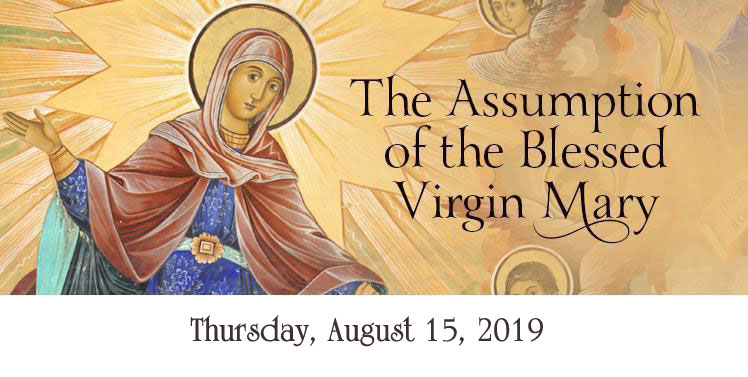
Thursday, August 15, 2019

Assumption feast invites people to look to heaven with hope, pope says


  • In Catholic News Service, Vatican
  • Carol Glatz
    Aug 15, 2019
  • Mary’s assumption into heaven calls people to put aside all those insignificant, mundane and petty concerns competing for their attention and instead be drawn to God and his greatness, Pope Francis said.

    After reciting the Angelus prayer on the feast of the Assumption Aug. 15, Francis also blessed thousands of rosaries that will be given to Catholics in Syria “as a sign of my closeness, especially for families who have lost someone because of the war.”
    “Prayers made with faith are powerful. Let us keep praying for peace in the Middle East and the whole world,” said the pope, who explained that Aid to the Church in Need spearheaded the initiative to send some 6,000 rosaries to Catholic communities in Syria.
    He also expressed his concern and prayers for those affected by monsoons in South Asia.
    A week of heavy rains triggered deadly landslides and flooding in India, where, according to government officials, nearly 300 people died and more than 1.2 million people were forced from their homes. Officials in Myanmar reported more than 50 people have died there.
    “May the Lord give strength to those (affected) and those who help them,” the pope said.
    With the assumption of Mary, body and soul, into heaven, she is “like a mother who waits for her children to come back home.” Knowing that she is there with God in heaven “gives us comfort and hope during our pilgrimage” on earth, he said.
    The feast of the Assumption of Mary is an invitation to everyone, “especially for those who are afflicted by doubt and sadness, and live gazing downward,” he said.
    “Let us look on high,” he said, where Mary awaits. “She loves us, she smiles at us and she comes to our aid with haste.”
    Just as every mother wants what is best for her children, “she tells us, ‘You are precious in God’s eyes; you were not made for measly worldly gratifications, but for the great joys of heaven,’” the pope said.
    In life, it is important to seek what is truly great, “otherwise we get lost” chasing after so many trivial things, he said.
    “Mary shows us that if we want our life to be happy, God goes first because only he is great,” he said.
    “Instead, how often we live chasing after things that don’t matter: Prejudices, grudges, rivalries, jealousies, illusions, superfluous material goods. How much pettiness in life!”
    But today, “Mary invites us to lift our gaze up to the great things that the Lord has done for her” and reminds people that the Lord also does great things in them.
    “Let us be attracted by true beauty, let us not be swallowed up by the petty things of life, but let us choose the greatness of heaven,” he said.

    https://cruxnow.com/vatican/2019/08/15/assumption-feast-invites-people-to-look-to-heaven-with-hope-pope-says/

    Sunday, August 11, 2019

    Gemma Tognini: Law needs to recognise that a dead child is not ‘just a foetus’

    Illustration: Getty Images


    I’ve got a question, two actually, and I’m happy to be judged on their merits because I think the issue is important.
    Who gets to decide when an unborn baby matters? Furthermore, who gets to say what worth is placed on the life of an unborn child when that life is ended either intentionally or recklessly by a criminal act?
    Because they were not born, their lives aren’t acknowledged as more than a biological extension of their mother. The law in NSW does not look at what happened to Katherine and see three lives lost.
    No, the law in NSW — and in WA — sees the death of an unborn child as one of the mother’s injuries. The law says a baby must show independent life outside a mother’s body to be deemed a living person, and therefore a victim of crime.
    The law, as they say, is an ass.
    Who got to decide this, and when? Why is there such resistance to reforming this part of the Criminal Code?
    Those unborn twin boys were mourned in their own right. Relatives told media “these babies were already part of the family”. They were mourned to some degree by each one of us who read the story and wept a little on the inside.
    Like most of us, I know couples who’ve gone through the trauma of late-term miscarriage or stillbirth. Maybe you’re one of them.
    You can’t tell me the babies you lost were nothing more than a bunch of cells attached to a life source. They were your children.
    Disagree? OK, let’s have some real talk, some adult talk if you’re up for it.
    How many of you have ever been invited to a foetus shower? Didn’t think so. We hold baby showers to celebrate the pending arrival of a unique life, brimming with promise. An expecting couple doesn’t get asked, what sex is your foetus or, have you chosen a name for your foetus? I could go on, but best I don’t.
    Try telling parents who’ve lost a baby, or a woman who has delivered a stillborn child, that that baby is ‘just a foetus’ and doesn’t deserve to be recognised.
    We call them babies when they’re born and foetus when we try to justify everything else. The language we use sanitises truth for the sake of our comfort, softens the blow when the blow is worthy of being felt.
    A spokesman for Attorney-General John Quigley said the State Government had no plans to review WA’s legislation.
    I want to know why not.
    In NSW, the reform agenda is known as Zoe’s law. In 2009, Zoe Donegan was stillborn at 32 weeks after her mother’s car was hit by a mini-van. Behind the wheel, a drug-addled driver. You should google the story. It will break your heart. Zoe’s law seeks to amend NSW law to make it a crime to harm or destroy a child in utero. The Bill is yet to be passed and remains in limbo.
    A lot of the pushback on this kind of legislative change has come from pro-choice campaigners who fret that adjusting the law could affect legislation around late-term abortion.
    To me, the two issues are separate.
    To conflate them is at best mischievous, at worst a terrible insult to the women who chose to keep their babies, but were robbed of their choice and their children by a crime.
    What we’re talking about here is an appropriate penalty for criminal acts, and about recognising that life is precious, at every stage. If the law is drafted correctly, not reactively or in haste, there’s no need for concern.
    Murdoch University lecturer Lorraine Finlay is a former State prosecutor, a former associate to Justice Dyson Heydon in the High Court (among many other things) and has written extensively on the topic.
    She says while the concerns of pro-choice campaigners are important, the issues are not automatically interlinked. She wrote recently that the law can be drafted so that it has no broader implication for either abortion or the legal rights of pregnant women.
    As a society, we acknowledge that life, at every stage, matters.
    If it didn’t, we wouldn’t have such stringent, well-debated and carefully drafted abortion laws in Australia.
    The taking of life, either medically or via a reckless or intentional criminal act, is a monumental thing and as a society we recognise that.
    We don’t need to have further conversations around existing abortion laws. It’s about looking at current holes in the Criminal Code and plugging them. It’s about recognising that most of the difficult and complex social issues we face are worth the subsequent awkward and uncomfortable conversations.
    Try telling parents who’ve lost a baby, or a woman who has delivered a stillborn child, that that baby is “just a foetus” and doesn’t deserve to be recognised. You just wouldn’t.
    I mean, at the very least, stop and ask yourself, how would I feel if it were me, would current laws be enough?
    This conversation is about as fun as walking barefoot through a paddock full of doublegees.
    But here’s the thing — two ideas can and should be able to coexist in tension. This is no different — probably more emotive, but at the heart of it, no different.
    Zoe’s life counted. The lives of Katherine Hoang’s unborn twin sons, counted. The law needs to reflect that.

    Gemma Tognini is managing director of GT Media


    Yale Uni. professor Doctor David Gelernter renounces Darwinism


    darwin-pigeon


    "My argument is with people who dismiss intelligent design without considering, it seems to me — it's widely dismissed in my world of academia as some sort of theological put up job — it's an absolutely serious scientific argument…. In fact it's the first and most obvious and intuitive one that comes to mind. It's got to be dealt with intellectually".
    Dr. David Gelernter


    Renowned Yale Professor
    Quits Darwin
     
    by Stephen Wynne  •  ChurchMilitant.com  •  August 8, 2019                                                      
     
    Dr. David Gelernter: Darwinism can't explain origin of species
     
    NEW HAVEN, Conn. (ChurchMilitant.com) - Famed Yale University computer science professor Dr. David Gelernter has renounced Darwinism.
    In a column for the spring edition of the 
    Claremont Review of Books, Gelernter announced that he is no longer a disciple of Darwin, saying the English naturalist's theory has been disproven.

    "Darwinian evolution is a brilliant and beautiful scientific theory," he wrote. "Once it was a daring guess. Today it is basic to the credo that defines the modern worldview."
    "Accepting the theory as settled truth ... certifies that you are devoutly orthodox in your scientific views; which in turn is an essential first step towards being taken seriously in any part of modern intellectual life," he added. "But what if Darwin was wrong?"In his seminal work The Origin of Species (1859), Darwin proposed that all life forms have descended from a common ancestor, suggesting that over time, random variation coupled with natural selection gives rise to entirely new species.
    But, Gelernter wrote, "The origin of species is exactly what Darwin cannot explain."
    "Darwin successfully explained the small adjustments by which an organism adapts to local circumstances: changes to fur density or wing style or beak shape," he noted. "Yet there are many reasons to doubt whether he can answer the hard questions and explain the big picture — not the fine-tuning of existing species but the emergence of new ones."
    Dr. Stephen Meyer A key problem for Darwinism, Gelernter said, is the Cambrian explosion. The fossil record reveals that "a striking variety of new organisms — including the first-ever animals — pop up suddenly in the fossil record over a mere 70-odd million years," which contradicts Darwin's assumption that "new life forms evolve gradually from old ones in a constantly branching, spreading tree of life."
    Chief among the flaws undermining Darwinism, he wrote, is molecular biology, which in recent decades has demonstrated that random mutation plus natural selection cannot give rise to new, more complex species.
    Gelernter credited three books for his shift in understanding: Dr. Stephen Meyer's Darwin's Doubt (2013), Dr. David Berlinski's The Deniable Darwin and Other Essays (2009) and David Klinghoffer's Debating Darwin's Doubt (2015).
    "These three form a fateful battle group that most people would rather ignore," he wrote.
    Gelernter singled out Meyer's work as especially praiseworthy: "Meyer ... disassembles the theory of evolution piece by piece. Darwin's Doubt is one of the most important books in a generation. Few open-minded people will finish it with their faith in Darwin intact."
     
    Darwinism is no longer just a scientific theory but the basis of a worldview, and an emergency replacement religion for the many troubled souls who need one. ….
     
    Meyer, director of the Center for Science and Culture at Seattle-based think tank the Discovery Institute, is an advocate of a replacement theory, intelligent design (ID).

    Biological life, ID proponents argue, is not the result of blind, undirected evolutionary processes, but the product of design by an intelligent entity.

    Many adherents are religious. But, as Gelernter observed, "Intelligent design as Meyer explains it never uses religious arguments, draws religious conclusions, or refers to religion in any way."

    Still, as ID has grown as a theoretical alternative to Darwinism, it has been savaged as a pseudo-scientific appeal to religion by committed Darwinists within the scientific establishment. This, Gelernter pointed out, is because Darwinism serves as their de facto faith:
     
    The religion is all on the other side. Meyer and other proponents of I.D. are the dispassionate intellectuals making orderly scientific arguments. Some I.D.-haters have shown themselves willing to use any argument — fair or not, true or not, ad hominem or not — to keep this dangerous idea locked in a box forever. They remind us of the extent to which Darwinism is no longer just a scientific theory but the basis of a worldview, and an emergency replacement religion for the many troubled souls who need one.
    Critics have long argued that Darwinism is atheistic philosophy disguised as science. Since Darwin's day, they note, it has been used to reject Christian orthodoxy and advance materialism, the view that human beings are merely the accidental results of unguided natural processes (as opposed to being purposefully created by God), and that the human mind is the only — and therefore, the supreme — consciousness that exists.
    I am attacking their religion and I don't blame them for being all head up, it is a big issue for them. ….
     
    In a 1997 article for The New York Review of Books, leading evolutionist and atheist Dr. Richard C. Lewontin testified to the fact that materialists are committed to Darwinism, in spite of its myriad inconsistencies and flaws, because they are committed to the denial of God.
     
    We take the side of science in spite of the patent absurdity of some of its constructs, in spite of its failure to fulfill many of its extravagant promises of health and life, in spite of the tolerance of the scientific community for unsubstantiated just-so stories, because we have a prior commitment, a commitment to materialism. It is not that the methods and institutions of science somehow compel us to accept a material explanation of the phenomenal world, but, on the contrary, that we are forced by our a priori [pre-existing] adherence to material causes to create an apparatus of investigation and a set of concepts that produce material explanations, no matter how counterintuitive, no matter how mystifying to the uninitiated. Moreover, that materialism is absolute, for we cannot allow a Divine Foot in the door.
     
    Gelernter worries that materialists' philosophical/religious commitment to Darwinism is precluding genuine scientific inquiry. In an interview with Stanford University's Hoover Institution last month, he expounded on this concern.

    "My argument is with people who dismiss intelligent design without considering, it seems to me — it's widely dismissed in my world of academia as some sort of theological put up job — it's an absolutely serious scientific argument," he said. "In fact it's the first and most obvious and intuitive one that comes to mind. It's got to be dealt with intellectually." ….


    Tuesday, July 30, 2019

    Pro-life protestors picket NSW parliament over abortion bill

    Monday, July 15, 2019

    Zodiac depicted at Göbekli Tepe?


    Vulture-Stone

     
    “From the last chapter the reader will recall Michael Rappengluck’s work on the zodiacal constellation of Taurus, depicted at Lascaux some 17,000 years ago as an auroch (ancient species of wild cattle) with the six visible stars of the Pleiades on its shoulder”.
     
    Graham Hancock


    Already I (Damien Mackey) touched upon some of Michael Rappengluck’s archaeoastronomical insights about the Lascaux cave depictions in the first of my multi-part series:
     
    So-called Paleolithic man was not dumb. Part One: Long cultural tradition of sky watching
     
    https://www.academia.edu/38355575/So-called_Paleolithic_man_was_not_dumb._Part_One_Long_cultural_tradition_of_sky_watching


    The date for Lascaux as given here by Graham Hancock in his book Magicians of the Gods (2015), I personally would consider to be thousands of years too early.
    That same book I was reading - and generally enjoying - last night and came upon this section most relevant to my series and to the findings of Michael Rappengluck:
     
    Neolithic puzzle
     
    [Paul] Burley’s paper is entitled “Göbekli Tepe: Temples Communicating an Ancient Cosmic Geography.” He wrote it originally in June 2011 … in February 2013 he asked me to read his paper, which he said concerned “evidence of a zodiac on one of the pillars at Göbekli Tepe.” I read it, replied that I found it “very persuasive and interesting, with significant implications” ….
     
    “Significant implications,” I now realize as I read through the paper again in my hotel room in ŞanlIurfa, was a huge understatement. But I didn’t make my first visit to Göbekli Tepe until September 2013 and by then, clearly, I’d forgotten the gist of Burley’s argument, which focuses almost exclusively on Enclosure D and on the very pillar, Pillar 43, that I’d been most interested in when I was there.
    My interest in it had been sparked by Belmonte’s suggestion that the relief carving of a scorpion near its base (which the reader will recall was hidden by rubble that Schmidt refused to allow me to move) might be a representation of the zodiacal constellation of Scorpio. ….
    Here’s where he gets to his point:
     
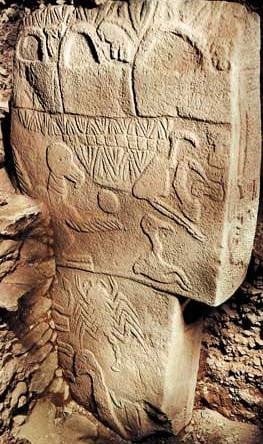
    One of the limestone pillars [in Enclosure D] includes a scene in bas relief on the upper portion of one of its sides. There is a bird with outstretched wings, two smaller birds, a scorpion, a snake, a circle, and a number of wavy lines and cord-like features. At first glance this lithified menagerie appears to be simply a hodgepodge of animals and geometrical designs randomly placed to fill in the broad side of the pillar.
     
    The key to unlocking this early Neolithic puzzle is the circle situated at the center of the scene. I am immediately reminded of the cosmic Father—the Sun. The next clues are the scorpion facing up toward the sun, and the large bird seemingly holding the sun upon its outstretched wing. In fact the sun figure appears to be located accurately on the ecliptic with respect to the familiar constellation of Scorpio, although the scorpion on the pillar occupies only the left portion, or head, of our modern conception of that constellation. As such the sun symbol is located as close to the galactic center as it can be on the ecliptic as it crosses the galactic plane.
     
    ….
     
    Burley then presents a graphic that “illustrates the crossing of the galactic plane of the Milky Way near the center of the galaxy, with several familiar constellations nearby.” A second graphic shows the same view with the addition of the ancient constellations represented on the pillar:
     
    Note that the outstretched wings, sun, bird legs and snake all appear to be oriented to emphasize the sun’s path along the ecliptic … The similarity of the bas relief to the crossing of the ecliptic and galactic equator at the center of the Milky Way is difficult to reject, supporting the possibility that humans recognized and documented the precession of the equinoxes thousands of years earlier than is generally accepted by scholars … Göbekli Tepe was built as a symbolic sphere communicating a very ancient understanding of world and cosmic geography. Why this knowledge was intentionally buried soon afterward remains a mystery.
     
    ….
     
    As I sit in my hotel room in ŞanlIurfa in July 2014 spinning the skies on my computer screen, I’m coming more and more to the conclusion that Paul Burley has had a genius insight about the scene on Pillar 43 at Göbekli Tepe. Burley’s language in his paper is careful—almost diffident. As we saw in Chapter Fourteen, he says that “the sun figure appears to be located accurately on the ecliptic with respect to the familiar constellation of Scorpio.” He speaks of other “familiar constellations” nearby.
    And he draws our attention to the large bird—the vulture—“seemingly holding the sun upon an outstretched wing.”
    He does not say which constellation he believes the vulture represents, but the graphics he includes to reinforce his argument leave no room for doubt that he regards it as an ancient representation of the constellation of Sagittarius. ….
     
    We’ve already seen that there is evidence for the identification of constellations going far back into the Ice Age, some of which were portrayed in those remote times in forms that are recognizable to us today.
    From the last chapter the reader will recall Michael Rappengluck’s work on the zodiacal constellation of Taurus, depicted at Lascaux some 17,000 years ago as an auroch (ancient species of wild cattle) with the six visible stars of the Pleiades on its shoulder.
     
    Acknowledging such surprising continuities in the ways that some constellations are depicted does not mean that all the constellations we are familiar with now have always been depicted in the same way by all cultures at all periods of history. This is very far from being the case. Constellations are subject to sometimes radical change depending on which imaginary figures different cultures choose to project upon the sky. For example, the Mesopotamian constellation of the Bull of Heaven and the modern constellation of Taurus share the Hyades cluster as the head, but in other respects are very different. …. Likewise the Mesopotamian constellation of the Bow and Arrow is built from stars in the constellations that we call Argo and Canis Major, with the star Sirius as the tip of the arrow. The Chinese also have a Bow and Arrow constellation built from pretty much the same stars but the arrow is shorter, with Sirius forming not the tip but the target. ….
     
    Even when constellation boundaries remain the same from culture to culture, the ways in which those constellations are seen can be very different.
    Thus the Ancient Egyptians knew the constellation that we call the Great Bear, but represented it as the foreleg of a bull. They saw the Little Bear (Ursa Minor) as a jackal. They depicted the zodiacal constellation of Cancer as a scarab beetle. The constellation of Draco, which we see as a dragon, was figured by the Ancient Egyptians as a hippopotamus with a crocodile on its back. ….
     
    There can therefore be no objection in principle to the suggestion that the constellation we call Sagittarius, “the Archer”—and depict as a centaur man-horse hybrid holding a bow with arrow drawn—could have been seen by the builders of Göbekli Tepe as a vulture with outstretched wings.
     
    I spend hours on Stellarium toggling back and forth between the sky of 9600 BC and the sky of our own epoch, focusing on the region between Sagittarius and Scorpio—the region Burley believes is depicted on Pillar 43—and looking at the relationship of the sun to these background constellations.
     
    The first thing that becomes clear to me is that a vulture with outstretched wings makes a very good figure of Sagittarius; indeed it’s a much better, more intuitive and more obvious way to represent the central part of this constellation than the centaur/archer that we have inherited from the Mesopotamians and the Greeks. This central part of Sagittarius (minus the centaur’s legs and tail) happens to contain its brightest stars and forms an easily recognized asterism often called the “Teapot” by astronomers today—because it does resemble a modern teapot with a handle, a pointed lid and a spout. The handle and spout elements, however, could equally effectively be drawn as the outstretched wings of a vulture, while the pointed “lid” becomes the vulture’s neck and head.
     
    It is the outstretched wing in front of the vulture—the spout of the teapot—that Burley sees as “holding the sun,” represented by the prominent disc in the middle of the scene on Pillar 43.
     

    …. 
    Figure 49: A vulture with outstretched wings makes a much better, more intuitive and more obvious way than an archer to represent the bright, central “Teapot” asterism within the constellation of Sagittarius.
    ….
      
    Figure 50: Sagittarius and neighboring constellations as interpreted on Pillar 43.
     ….

    But the vulture and the sun are only two aspects of the complex imagery of the pillar. Below and just a little to the right of the vulture is a scorpion.
    Above and to the right of the vulture is a second large bird with a long sickle-shaped beak, and nestled close to this bird is a serpent with a large triangular head and its body coiled into a curve. A third bird, again with a hooked beak, but smaller, with the look of a chick, is placed below these two figures—again to the right of the vulture, indeed immediately to the right of its extended front wing. Below the scorpion is the head and long neck of a fourth bird. Beside the scorpion, rearing up, is another serpent.
     
    Part of the reason for my growing confidence in Burley’s conclusion, though he makes little of it in his paper, is that these figures, with only minor adjustments, compare intriguingly with other constellations around the alleged Sagittarius/vulture figure.
     
    First and foremost, there is the scorpion below and a little to the right of the vulture, which we’ve seen already has an obvious resemblance to Scorpio, the next constellation along the zodiac from Sagittarius. Its posture and positioning are wrong—we’ll look more closely into the implications of this in a moment—but it’s there and it is overlapped by the tail end of the constellation that we recognize as Scorpio today.
    Secondly, there’s the large bird above and to the right of the vulture with the curved body of a serpent nestled close to it. These two figures are in the correct position and the correct relationship to one another to match the constellation we call Ophiuchus, the serpent holder, and the serpent constellation, Serpens, that Ophiuchus holds.
     
    Thirdly, immediately to the right of the extended front wing of the vulture there’s that other bird, smaller, like a chick, with a hooked beak. I email Burley about this, and about the different position and orientation of the scorpion on the pillar and the modern constellation of Scorpio, and we arrive, after some back and forth, at a solution. Constellation boundaries, as the reader will recall, are not necessarily drawn in the same place by all cultures at all periods and it’s clear that there’s been a shift over time in the constellation boundaries here. The chick on Pillar 43 appears to have formed a small constellation of its own in the minds of the Göbekli Tepe astronomers—a constellation that utilized some of the important stars today considered to be part of Scorpio. The chick’s hooked beak is correctly positioned, and its body is the correct shape, to match the head and claws of Scorpio. ….
     
    Fourthly, beside the scorpion on Pillar 43 is a serpent and beneath the scorpion are the head and long neck of yet another bird, with a headless anthropomorphic figure positioned to its right. The serpent matches the tail of Sagittarius (as we’ve seen, the vulture appears to be composed from the central part of Sagittarius only—the Teapot—so this leaves the remainder of the constellation available to the ancients for other uses). The best contenders for the bird, and for the peculiar little anthropomorphic figure to its right are parts of the constellations we know today as Pavo and Triangulum Australe. The remainder of Pavo may be involved with further figures present on the pillar to the left of the bird.
     
    As is the case with Sagittarius, elements of the modern constellation of Scorpio have been redeployed in the ancient constellations depicted on Pillar 43. Only the tail of our Scorpio is in the correct location to match the scorpion on Pillar 43 and its head faces to the right, whereas the head of the scorpion on the pillar faces to the left.
    The scorpion on the pillar is also below the vulture, whereas modern Scorpio is a very large constellation lying parallel and to the right of Sagittarius.
    I suggest the solution to this problem is that the scorpion on Pillar 43 is conjured from a combination of the tail of the modern constellation of Scorpio (right legs of the Pillar 43 scorpion), an unused part of the “Teapot” asterism of Sagittarius (right claw of the Pillar 43 scorpion) and the constellations that we know as Ara, Telescopium and Corona Australis (respectively the tail, left legs and left claw of the Pillar 43 scorpion). Meanwhile, as noted above, the claws and head of the modern constellation of Scorpio have been co-opted to form the chick with the hooked beak on Pillar 43.
     
    This whole issue of the relationship between the modern constellations of Scorpio and Sagittarius and the scorpion and vulture figures depicted on Pillar 43 takes on a new level of significance when we remember that in some ancient astronomical figures Sagittarius is depicted not only as a centaur—a man-horse—but also as a man-horse hybrid with the tail of a scorpion, and sometimes simply as a man-scorpion hybrid. …. On Babylonian Kudurru stones (often referred to as boundary stones, although it is likely that their function has been misunderstood …) a figure of a man-scorpion drawing a bow frequently appears that “is universally identified with the archer Sagittarius.” …. What further cements the identification of Sagittarius with the vulture on Pillar 43 is that these man-scorpion figures from the Babylonian Kudurru stones are very often depicted with the legs and feet of birds. …. Moreover, in some representations a second scorpion appears beneath the body—i.e. beneath the Teapot asterism—of Sagittarius … reminiscent of the position of the scorpion on Pillar 43 (see Figures 50 and 51).
     

    Figure 51: Man-scorpion Sagittarius figures from Bablylonian Kudurru stones (left) are frequently depicted with the legs and feet of birds, further strengthening the identification of the vulture figure on Pillar 43 with Sagittarius. In other Mesopotamian representations (right) we see a second scorpion beneath the body of Sagittarius occupying a similar position to the scorpion on Pillar 43.
    ….
     
    When all this is taken together it goes, in my opinion, far beyond anything that can be explained away as mere “coincidence.” The implication is that ideas of how certain constellations should be depicted that were expressed at Göbekli Tepe almost 12,000 years ago [sic], including the notion that there should be a scorpion in this region of the heavens, were passed down, undergoing some changes in the process, but nonetheless surviving in recognizable form for millennia to find related expression in much later Babylonian astronomical iconography. But given the close connections with ancient Mesopotamia, its antediluvian cities, its Seven Sages and its flood survivors washed up in their Ark near Göbekli Tepe, we should perhaps not be too surprised.