Translate

Sunday, June 2, 2019

Professor Giertych’s assault on evolution


"... all scientific evidence points to a decline".
Professor Maciej Giertych


THE ARROW POINTS DOWN:
 
THE ROLE OF INFORMATION IN BIOLOGY
 
By
Dr. Maciej Giertych


Life is more than just chemistry and physics. It also includes information. Information is part of biological reality. We can study it from the point of view of molecular biochemistry but also in terms of mathematical relations, logic and transformation.
 
 
Comparison with Computers
 
There is some analogy with computers. A computer has a shape, dimensions, a chemical composition, physical parameters etc. All of this we refer to as hardware. But there is also software, currently much more expensive than hardware. We have the programs, the databases, the files, the calculation sheets etc. Without the software, a computer is a pile of junk. With the software in place it does not change its shape, weight, or the chemistry of physical parameters, but it becomes functional.
 
Working with computers we have learned certain facts about the role of information in dealing with almost anything. We know that a program can become spoiled on its own through faults in the discs that carry the program. We know that we can spoil a program by mistake. We know that it will never correct itself. By accident it will not become better or more useful. After an accidental change the number of functions a program has will not increase. We know also that an error can protect a word or file from being erased when deletion is commanded. A computer program has an intended plan, a purpose meant for it by the programmer. There is an intelligent input.
 
Breeders
 
Similarly a breeder has a plan, a purpose, and a direction for the intended improvement. However, a breeder does not create new information. He only selects among the information available in nature and strives for such a combination of it so as to direct the breeding program towards the desired improvement.
 
Natural reproductive processes maintain biodiversity through recombination. Natural selection acts on existing forms. It reduces the number of forms by eliminating genotypes that are not adapted in the given environmental conditions. It does not create anything new. Breeders replace natural selection with their own, favoring what meets human needs.
 
Physicists
 
In the physics of micro- and macro-cosmos there are doubts about the probabilistic model of explaining reality. There is a school of thinking that favors an information model. They speak of the Unitary Information Field Approach (UIFA) assuming that somewhere there is information that is being realized in the functioning of the cosmos. They envy biologists that have found their Information Field in the genetic code. It needs to be pointed out that we have known where this information is located only since mid 20th century. When the theory of evolution was proposed, and during the time its role in dominating biological thinking developed the most, we had no idea that information for the realization of biological systems existed and was specifically located in a particular place within a living cell.
 
 
Fate of Information
 
Now let us look at what happens to the information accumulated in the genetic code during the functioning of biological systems, or when man manipulates these systems. In Table 1, some of these biological functions and human activities are listed, segregated into those that reduce information, mix information and increase information.
 
Table 1. Fate of information in living systems.
 
--------------------------------------------------------------------------------------------------------
 
INFORMATION
 
--------------------------------------------------------------------------------------------------------
Reduction Recombination Growth
--------------------------------------------------------------------------------------------------------
 
Isolation Panmixy
 
Inbreeding, self-pollination Hybridization, introgression
 
Transformations, engineering
 
Genetic drift Meiosis, crossing-over
 
Selection Heterozygocity protects recessives
 
Adaptation Migration
 
Domestication Protection of gene resources
 
Improvement Care for biodiversity
 
Breeding Increasing heterozygocity
 
Race formation Going wild, mongrelization
 
--------------------------------------------------------------------------------------------------------
 
Deleterious mutations Positive mutations
 
--------------------------------------------------------------------------------------------------------


Reduction of Information
 
Isolation of a biological population will lead to a reduction of genetic information. Inbreeding is the consequence of isolating a population.
Sexual reproduction occurs between relatives and, in extreme cases, we see self-pollination. This always leads to accidental loss of some information. This loss of some genes is referred to as genetic drift. (This can be compared to the accidental reduction in the number of surnames in a small group of colonists who are left without new arrivals for several generations. Such a phenomenon was known to have occurred on several Caribbean Islands during the 18th and 19th centuries). A gene once lost is lost forever. It does not reconstitute itself. It can only reappear if it is reintroduced.
 
Selection acts much faster. Forms that are not adapted to a given environment will perish together with their genes responsible for the lack of adaptation. As a result a population develops that is adapted to the specific conditions of the place, adapted in the sense that it is deprived of the genotypes that are unable to live in this environment. The gene pool is reduced relative to the one it was derived from. One can observe some vegetation on industrial spills. Many seed fall there, but only a few survive. The population that develops there may be adapted to the spill, e.g., a high level of heavy metals, but it is genetically much poorer than the population of seed that fell on the spill.
 
Based on this adaptation mechanism, much work has been done by breeders leading to the domestication of plants and animals. The domesticated plants and animals are genetically poorer that the wild organisms they were derived from. When we speak of genetic improvement we mean "improvement" from the human point of view. The yield of sugar from sugar beets is increased or the yield of milk from a cow. But this is always at the expense of some other functions, and results in the "improved" varieties becoming less able to live in natural conditions, becoming dependent on man. The more improved the varieties, the more dependent on humans they are and the poorer they are in genetic diversity.
 
Breeding, as well as natural adaptation, leads to the formation of races. Races are genetically poorer than populations they were derived from. All races of dogs can be bred from wild wolves, but it is not possible to breed a St. Bernard from a terrier.
 
It is of course well known that mutations can destroy genes. Since mutagenic agents (radiation, chemicals) bombard us all the time, the number of damaged, and therefore defective genes in any population increases. We speak of an increase in the genetic load. When such defective genes meet in a homozygote, the defect shows, and natural selection eliminates the genotype with the defect.
 
Reshuffling of Information
 
Population genetics recognizes recombination of genes as the primary source of variation in nature. It is universally accepted that panmixy occurs in nature. Panmixy is the random meeting of gametes in the process of sexual reproduction. Each gamete (pollen grain, sperm, ovule, egg cell) has its own genetic identity, and therefore, when two combine, a new entity arises.
 
In extreme cases we have hybridization, the meeting of gametes from different species.
When the hybrid is viable and fertile with one of the parental species we get introgression, the entering of genes of one species into the population of another.
 
Transformation is the transfer of genes from one population to another by some other method than through sexual reproduction. A parasite may introduce its genes into the genome of the host to use its metabolism for its own purposes. A sawfly will cause a willow leaf to produce a gall that is useless for the willow but is a home for the sawfly. The genetics of the willow was modified. Its metabolic potential was utilized according to genetic information from a foreign entity. Now we do the same in genetic engineering. We transfer genes from a fish to a tomato. We produce modified organisms referred to as transgenic. We mix genes from organisms that do not hybridize in nature.
 
In sexual reproduction we observe a mechanism for the mixing of genetic information at the reduction division. During meiosis the information inherited from the father and the mother is reshuffled. During pachytene, crossing over of chromatid parts occurs. During anaphase, homologous chromosomes separate and, together with the parts exchanged during crossing over, they travel to the opposite poles. In the process the chromosomes (or their parts) originating from father and mother get mixed so that each resultant haploid gamete is genetically different.
 
If a haploid gamete contains a gene that is not adapted to a particular environment or in some way defective, this will cause difficulties to the gametophyte, resulting in it being impoverished or simply perishing. In this way defective or non­adapted genes get lost. However after fertilization, in a diploid zygote and the resultant sporophyte, the non-adapted or defective gene can survive, thanks to the presence of a functional homologous one from the fertilization partner. This is referred to as dominance of some genes over recessive ones. The net result is heterozygocity or genetic biodiversity in the population. This is a natural mechanism for the protection of genes useless in a given environment, but possibly useful in another, in which some descendant will happen to live. Unfortunately this is also a mechanism that protects defective genes, the genetic load, as it is called.
 
Gene mixing results also from plant and animal migration. Each species constantly places some of its progeny beyond its current range of occurrence. Man also frequently transfers populations beyond their natural ranges. The new arrivals, whether naturally or artificially introduced, if they find it possible to interbreed with the local populations, become a source of an increase in the genetic biodiversity. As new territories are being colonized by a species, sometimes separate waves of colonization from different refugia meet, and then recombination between them occurs, giving a rich genetic diversity of the population.
 
Seeing the genetic resources of our planet decline, man has made efforts to protect them. We now often speak about the protection, or even promotion, of biodiversity. It needs to be stressed that breeding and gene pool protection have opposite effects on genetic information. However, in breeding work it is possible to deliberately increase heterozygocity to assure greater stability of the improved population. Highly bred pure lines are especially hybridized to achieve heterozygocity. The breeding population is often deliberately kept diversified to counteract the loss of genes accompanying selection.
 
Highly bred and improved plants and animals need human protection. Usually they need special environmental conditions that only man can supply (fertilizers, fodder, antibiotics, pesticides, herbicides etc.). But not only that. They require human protection from outbreeding. They have to be kept isolated. Once the isolation is discontinued, we get mongrels; selected varieties go wild.
 
Increase of Information
 
There is only one mechanism that is credited with increasing genetic information. It is mutagenesis. It is assumed that once in a while a mutation occurs that is positive, in the sense that it increases the survival potential of the individual, and of the population derived from it. A positive mutation is the only possible source of new information. The whole theory of evolution hinges on the existence of positive mutations. But do we have good examples of them?
 
Darwinian Evolution

Darwin observed variation within species (beaks of finches). He observed adaptation to various environments and diversification of isolated populations (now referred to as genetic drift). What he observed was the consequence of recombination and of reduction of genetic information. Yet his conclusion was Evolution, a natural process giving growth of information.
His conclusion was wrong! Adaptation, often referred to as microevolution, is not an example of a small step in macroevolution. It is a process in the opposite direction!
 
In school textbooks the world over we find the example of the peppered moth Biston betularia that sits on the bark of birch trees. It was found to change its color to black when, in industrial areas, the bark of birches was soot covered. When the industrial soot was cleaned up, the peppered moth returned to its whitish gray color. This is an example of adaptation, reversible adaptation, since there was a breeding link with wild populations living outside the polluted area. Natural selection, birds feeding on the moths, leaves only those that are least seen when sitting on the birch bark. Genes for the dark color are present in the wild population and dominate it when environmental conditions demand it. The dark colored race has no new genetic information. It has only a portion of the information present in the wild genetic pool. In fact, only proportions of black and gray moths change. These are differences in numbers, not in kind.
 
[Editor's note: The peppered moth (Biston Betularia) experiment has been discredited in recent times, but evolutionists have not given up. See for example this article from Answers in Genesis.]
 
It must be stressed that the formation of races is not an example of a small step in evolution.
 
 
Lessons from Breeding
 
Breeding work has taught us several important things.
 
First of all, we now know that there is a limit to the possibility of breeding in any particular direction. The information content of a gene pool is finite. In breeding we can use what is available, and no more.
 
Secondly, we know that our improved varieties need isolation to maintain their improvement. Without the isolation they will go wild, interbreed with the wild varieties, and thereby lose their identity.
 
Thirdly, we know that highly bred and improved varieties are biologically weaker than the wild varieties.
 
We have painfully learned that wild varieties are absolutely necessary for breeding work. We must have the rich pool of genes in the wild conditions to be able to select from, and incorporate into, our bred varieties, as new demands on the breeding program are articulated.
 
To summarize, we must learn how to manage the resources of genetic information available to us in nature, because they are finite and can be irretrievably lost.
 
Mutations
 
Now a word is needed about mutations, the only potential source of new genetic information. We have been studying mutations for over 70 years and some definitive conclusions are permissible.
 
First of all we observe a general decline of interest in mutagenesis as a breeding method. Most laboratories all over the world are closing their mutagenic programs. Some useful varieties have been obtained through mutagenesis, but few and far between, and they are only useful from the human point of view. Some dwarf forms were obtained, useful as root stocks for grafting or for rock gardens. Some very sensitive plants were obtained that were good for monitoring pollution. A seedless variety of oranges was produced. There are many ornamental varieties of flowers that have been deprived of certain natural pigments by mutagenesis. In each case, however, the plant obtained is biologically poorer, and usually weaker than its unmutated progenitor. It is deprived of something that, in natural conditions, is useful.
 
We know of many mutations that are deleterious. We are afraid of them. We try to protect the wild gene pool and ourselves from various mutagenic agents. We discourage nuclear tests, redundant X-rays, asbestos, etc. If a mutagenic environment favors positive mutations it is deluged by a multitude of destructive, negative mutations.
 
We know of the existence of mutations that are biologically neutral. These are changes, either in the non-coding part of the genome or in the genetic code, but not affecting the functionality of the protein they code for. We refer to these variants as alleles. When copying a text we can make mistakes. If the mistakes do not alter the meaning of the text, we can refer to them as neutral. As long as the meaning is preserved, the changes are tolerated, but usually they are also considered a nuisance. Also in the genome, the information change - when neutral - is tolerated, but if it only slightly reduces functionality of the protein it codes for, then there will be selection against it. However, when the meaning is changed, when functionality is significantly altered, we can speak of a change, either negative or positive.
 
Positive mutations are more a postulate that an observation. Usually races of organisms resistant to man-made chemicals (herbicides, fungicides, pesticides, antibiotics, etc.) that have developed only after marketing the given product, are quoted as examples of positive mutations. When dealing with such arguments it is necessary, first, to realize that the new forms are not new species. They are usually interfertile with the original population, and usually disappear when the use of the chemical is stopped. Thus they appear similar to the reversible adaptation of Biston betularia. It is quite possible that the adaptation was similarly achieved, by recombination. There are very few examples where a documented change in the genome is responsible for the newly generated resistance to a chemical.
 
In the known examples it can be shown that the change involves a defense of natural functionality. It is not a creation of something new but a protection of something already existing.
 
Defense of Functionality
 
There are various ways in which functionality can be defended in the natural conditions.
 
Natural selection is one such mechanism. By eliminating defective forms natural selection protects the population from deteriorating.
 
Natural selection also occurs on the level of cells. Within a tissue defective cells will be eliminated and prevented from multiplying.
 
There are various mechanisms for correcting defects. Healing of wounds is one such mechanism. There are others, also on the genomic level. Defective nucleotide sequences can sometimes be corrected. Just as computer programs can have some back-up information allowing corrections, so do biological systems.
 
Finally biological systems have a method of identifying and neutralizing an invading foreign factor. On an individual level this is referred to as immunity. An invading protein is recognized and antibodies are custom made to neutralize it. This immunological adaptation can also occur on a population level. An organism that adapts its biology to the combating of the foreign chemical, multiplies and replaces the whole population that fell under the heavy selection pressure of the chemical. This has been particularly demonstrated for chemicals that were custom made to destruct a single vital protein in a specific organism. These chemicals are developed to attach themselves to a specific sector of the protein, with a specific sequence of amino acids. A mutation that is neutral (not affecting the functionality of the protein it codes for) but which alters the sequence of amino acids defining attachability of the chemical, can be considered positive from the organism's point of view. It frustrates the effectiveness of the chemical as a killing agent. But it is positive only because it protects existing functions, and not because it provides new functions or organs.
 
This in no way helps to support the theory of evolution.
 
Information and Time
 
There are two visions of the Universe. Relating those visions to information and time we can say that one vision starts with total chaos at the beginning of time (Big Bang) and sees gradual accumulation of information through evolution of particles, molecules, compounds, organic compounds, through life all the way to man and on towards an ever improving and, increasing in information content, glorious future. The other vision starts with a glorious, plentiful beginning, and then sees gradual corruption, extinction of species, deterioration of genes, dissipation of energy and movement towards an inevitable end of the visible reality. This is available to our senses and our scientific cognition for only a small sector of the time postulated in these visions.
 
The big question is: In the time available to us, do we see an increase of information, or its decline? As I see it, all scientific evidence points to a decline!
 

Wednesday, May 29, 2019

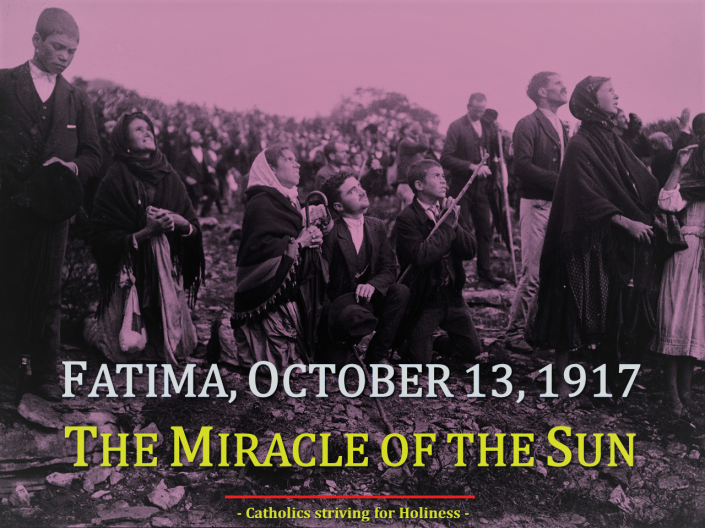
Eyewitness professor’s account of Fatima’s Miracle of the Sun


“Then, suddenly, one heard a clamor, a cry of anguish breaking from all the people.

The sun, whirling wildly, seemed all at once to loosen itself from the firmament and,

blood red, advance threateningly upon the earth as if to crush us with its huge

and fiery weight. The sensation during those moments was truly terrible”.
 

Dr. José Maria de Almeida Garrett


The Miracle of the Sun


An Eyewitness Account by Dr. José Maria de Almeida Garrett, professor at the Faculty of Sciences of Coimbra, Portugal


"It must have been 1:30 p.m when there arose, at the exact spot where the children were, a column of smoke, thin, fine and bluish, which extended up to perhaps two meters above their heads, and evaporated at that height. This phenomenon, perfectly visible to the naked eye, lasted for a few seconds.

Not having noted how long it had lasted, I cannot say whether it was more or less than a minute. The smoke dissipated abruptly, and after some time, it came back to occur a second time, then a third time.


"The sky, which had been overcast all day, suddenly cleared; the rain stopped and it looked as if the sun were about to fill with light the countryside that the wintery morning had made so gloomy. I was looking at the spot of the apparitions in a serene, if cold, expectation of something happening and with diminishing curiosity because a long time had passed without anything to excite my attention. The sun, a few moments before, had broken through the thick layer of clouds which hid it and now shone clearly and intensely.


"Suddenly I heard the uproar of thousands of voices, and I saw the whole multitude spread out in that vast space at my feet...turn their backs to that spot where, until then, all their expectations had been focused, and look at the sun on the other side. I turned around, too, toward the point commanding their gaze and I could see the sun, like a very clear disc, with its sharp edge, which gleamed without hurting the sight. It could not be confused with the sun seen through a fog (there was no fog at that moment), for it was neither veiled nor dim. At Fatima, it kept its light and heat, and stood out clearly in the sky, with a sharp edge, like a large gaming table. The most astonishing thing was to be able to stare at the solar disc for a long time, brilliant with light and heat, without hurting the eyes or damaging the retina. [During this time], the sun's disc did not remain immobile, it had a giddy motion, [but] not like the twinkling of a star in all its brilliance for it spun round upon itself in a mad whirl.


"During the solar phenomenon, which I have just described, there were also changes of color in the atmosphere. Looking at the sun, I noticed that everything was becoming darkened. I looked first at the nearest objects and then extended my glance further afield as far as the horizon. I saw everything had assumed an amethyst color. Objects around me, the sky and the atmosphere, were of the same color. Everything both near and far had changed, taking on the color of old yellow damask. People looked as if they were suffering from jaundice and I recall a sensation of amusement at seeing them look so ugly and unattractive. My own hand was the same color.


"Then, suddenly, one heard a clamor, a cry of anguish breaking from all the people. The sun, whirling wildly, seemed all at once to loosen itself from the firmament and, blood red, advance threateningly upon the earth as if to crush us with its huge and fiery weight. The sensation during those moments was truly terrible.


"All the phenomena which I have described were observed by me in a calm and serene state of mind without any emotional disturbance. It is for others to interpret and explain them. Finally, I must declare that never, before or after October 13 [1917], have I observed similar atmospheric or solar phenomena." ….


Professor Almeida Garrett's full account may be found in Novos Documentos de Fatima (Loyala editions, San Paulo, 1984)


Tuesday, May 28, 2019

A tilt at Copernicanism


“After all, even Copernicus' own system was by his own admission (read his original,
i.e. the first edition of De revolutionibus orbium coelestium) nothing more than a synoptic rehash of the already-existing diverse (part geocentric, part heliocentric, fire centric,
animal centric...) ideas of men like Hicetas, Ecphantus, Heraclides and Aristarchus”.


The "Rotating" Earth..
Theory, Fact or Fiction?
 
Oh what a tangled web we weave, when first we practice to deceive! --Sir Walter Scott
Throughout ancient times it was obvious that the moon went around the earth. This is still accepted today. But in the past it was just as obvious that the sun went around the earth as well. This was not because men in those days lacked fantasy and forgot to imagine non-existent movements of themselves and their surroundings. It is because they did their homework and examined all the evidence before them, that they came to the understanding that the earth was a firm, motionless sphere, neither in rotation around itself nor wandering through space around another body.
This geostatic and geocentric nature of the earth was repeatedly tested and verified as being factual for a quite some time (going back thousands of years) by knowledgeable, civilized, free people of all stripes, i.e. those who were supposed to know, like astronomers, natural philosophers (a.k.a. scientists), explorers, teachers, traders, seamen, navigators and various other free and educated men (as opposed to schooled, wage enslaved, homogenized, "experts" of modern times who wouldn't dare bite the hand that feeds them).
 
Then, all of a sudden, just 400 plus years ago, a band of court astrologers started pushing this idea that the earth was orbiting the sun this time, and that the sun was standing still at the center (hence the claim of the system being a 'solar' system). Nevertheless this new claim was not accompanied by any new proof. It was simply invoked and declarations were made that the fixed nature of earth needed to be disapproved.
 
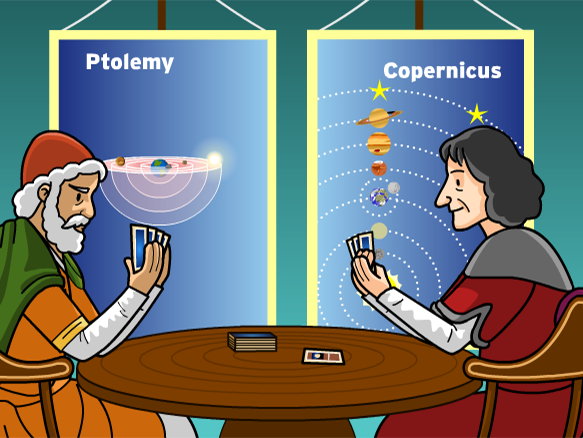
Then, various kinds of earth movements were claimed to have existence and, subsequently abstract calculations were made of the speed and other attributes of these imaginary movements - presenting the results as if they have measured an actual motion. The major and in fact the only reason that was brought up for advancing this whole idea was that the then mainstream Ptolemaic model of the universe was deemed inconvenient in explaining and predicting the movements of the planets as they appear in the sky (especially one particular kind of movement: the retrograde motion of the planets in the sky).
 
But all along it was (and still is) a fact that a stationary earth, situated at the center of the universe also accounts for those retrograde motions, as shown by astronomer Tycho Brahe for example. And, although Ptolemy's epicyclical system was the long established one, it did not have exclusive monopoly. There were many ideas and models in circulation - like those of Pythagoras, Philolaus, Jean Buridan, Martianus Capella, Nicholas of Cusa and René Descartes to name a few.
 
After all, even Copernicus' own system was by his own admission (read his original, i.e. the first edition of De revolutionibus orbium coelestium) nothing more than a synoptic rehash of the already-existing diverse (part geocentric, part heliocentric, fire centric, animal centric...) ideas of men like Hicetas, Ecphantus, Heraclides and Aristarchus. So then, all those years - and right up to now - nobody has ever succeeded in showing or even detecting any movement of the earth in space.
 
However this complete lack of scientific evidence is not admitted. Instead a smokescreen of hearsays, popular opinions, organizational rulings, majority votes, superficial analogies, "expert" testimonies, personal convictions and such other means of persuasion (none of which qualify as scientific proof) are proposed and presented in order to support the heliocentric theory.
 
Heliocentricity is not a logically plausible (let alone irrefutable) theory that is based on scientific data but is actually, purely based on a series of assumptions that were built-up over the last 200 years. For example many (but not all) of the assertions regarding astronomical distances between celestial bodies are based on the necessary assumption that the earth must be revolving around the sun.
 
But at the same time, these assumed distances have another function whereby they are deployed as some sort of supportive argument for the "trueness" of the heliocentric hypothesis.
For example we are told that sun is too big to revolve around the earth, despite the fact that the sun's size was determined in the first place by assuming how big it must have to be in order to allow a heliocentric premise! Go figure. Other needed assumptions include:
 
■ the bendover earth (alleged 'tilt' of the earth's axis - a desperately needed heliocentric variable that has no basis in the physical world where the sun simply spirals from the Tropic of Cancer to the Tropic of Capricorn annually. Both of these tropic latitude lines are not tilted - they are at a 0° angle (= parallel) to the equator. The word "tropic" itself comes from the Greek term tropos, meaning turn, referring to the fact that the sun "turns back" at these lines that aren't tilted in any way,
■ the earth supposedly jittering around the sun at various speed levels (it orbits at a faster speed at one time, and then it goes relatively slower at another - then back faster again) but somehow, all this alleged speed-change remains unnoticeable),
■ the moon also being dragged along exactly at those same speed levels (100% complete synchronization with the wobbly earth despite being hundreds of thousands of miles away from it(!) Now how about that?,
■ even atmospheric gas (the air) being attached to the earth's surface (again completely synchronized but somehow (simultaneously) free-flowing enough to blow in every direction). These are just samples of the never shown, never detected, never scientifically observed absurdities that are required to save the appearances of the heliocentric model.
 
Facts are facts
 
Heliocentrists have been known to point to certain geophysical and astronomical features as arguments which they claim supports their sun-centered view. For example they claim that the Cape Canaveral area in Florida is chosen as a site for NASA's rocket launch center because it is one of the more southern points on the U.S. mainland and therefore closest to the equator. The same argument comes up regarding the reason why Europe's rocket launch center is located in French Guyana (in South America). There is supposed to be an advantage to being close to the equator when the goal is to get a vehicle into orbit: the "rotating" earth supposedly creates a centrifugal force that supposedly "lifts" the missiles. Well, the truth is that there is no real advantage: China's Jiuquan space center is found all the way up in the far north of the country (Inner Mongolia province). Why did the Chinese choose this site, when they have vast territory much further south which is closer to the equator? In fact, portions of southern China are closer to the equator than to the northern cosmodrome, from where they toss their taikonauts into orbit. The Russians are also reported to be developing a new space launch facility, which will be located much north of the current Baikonur Cosmodrome in Kazakhstan. This all means that a rocket launched tangentially from the Earth's equator doesn't really provide a more advantageous escape-velocity!
 
Getting closer to the supposed existence of an "equatorial centrifugal force" on the surface of the "rotating" earth (and other bogus heliocentric claims) is like getting closer and closer to an apparent pool of water in the desert: it dissolves and disappears right before your eyes in a spectacular fashion! Another bogus argument that some solar system advocates bring up from time to time is inertia and momentum. What is it that the moving-earth theorists believe is the substance (or the vector field) that supposedly exerts a huge gravitational force on air molecules which prevents the atmosphere around the earth from trailing behind the allegedly speeding earth (as is the case for comets)? Their answer?: Nothing. Instead, heliocentrists usually propose a fraudulent analogy of how the earth's motion is comparable with some person walking inside a moving train.
They claim that since the walker inside the train feels more or less the same as he or she feels when walking on the ground that somehow is supposed to reassure us that the earth could also be moving without we feeling it.
 
The problem with this analogy is of course the fact that once the person inside the train opens a window and faces the elements, he or she will feel it soon enough what the real speed is that the train is traveling at! Therefore the only correct analogy for someone walking on the ground of earth is someone walking in an open train or better yet - on the roof of a moving train. What will [happen] … then?
 
Well, the person will instantly encounter a force that is proportional and in opposite direction to the moving train. But why? Isn't the surrounding air supposed to be following the train, just as we are told the atmosphere is allegedly doing so by keeping-up with the supposedly faster-than-bullet rotating earth? Looks like heliocentrists have decided to suspend the laws of physics (aerodynamics) just for this case of a badly needed moving earth theory!
 
But still somehow, this law of motion is supposed to apply in all other cases of moving things in the universe?! This contradiction is quietly adopted in order to hide the fact that there is a force that is causing an air drag or friction that wasn't there before the train arrived. The friction with the earth's surface wasn't there because, unlike the train, the earth didn't move!
 
Getting to the top (and bottom) of it
 
The star whose location is closest to the point vertically above north pole (= celestial pole) is Polaris, a.k.a. the North Star, around which all the other stars appear to rotate (as visible during the night). Now, why is it that only one single star is a pole star throughout the whole year? All kinds of other stars should have taken turn to become pole stars if the earth was slinging around the sun. But since that is not the case and Polaris remains the most northerly of the stars all year round, as seen on photographs of star-trails (see below), it can only mean that the earth is not orbiting the sun. Moreover, a moving and orbiting earth would have caused the paths of stars to appear as (spiral) lines instead of fully circular tracks that we observe night after night, and consequently the shapes of the constellations would have changed considerably over the course of a single year. So what we're looking at is what is real - WYSIWYG: stars orbiting the Earth once a sidereal day, i.e. the time it takes for a celestial object to rotate 360°. For the stars around the Earth this is: 23 hours, 56 minutes and 4.091 seconds.
 
Truth has a way of being indestructible. It may or may not be popular at any given time, it may even be barely noticeable, but it is always there. And it turns out that the truth actually gets in the way of "science"! Modern theoretical (non-applied a.k.a 'pure') physics is not really science-driven but agenda-driven. It is populated with heavily politicized academia. It has become nothing much more than a sham propaganda-exercise of empty eloquence with false authority. The inventor of the electric world we live in, Nikola Tesla was spot-on when he remarked that modern non-applied science has become nothing more than manipulative indulgence in fancy "thought experiments" and abstract, fuzzy math which have no relation to reality. Instead of the theories being made to fit reality, what we have is the opposite: reality being adjusted or in fact completely overthrown, in order to fit agenda-driven theories and models. ….

Saturday, May 25, 2019

Pope Francis says abortion is like 'hiring a hitman' amid heartbeat law protests splitting US


Pope Francis says abortion is like 'hiring a hitman' amid heartbeat law protests splitting US
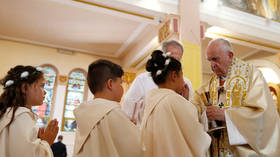
Bulgarian Catholic children receive their First Communion given by Pope Francis during the Holy Mass at Most Holy Heart of Jesus church in Rakovski, Bulgaria May 6, 2019. © REUTERS/Yara Nardi
 
The pontiff, who is known for his outspoken aversion to the practice, tore into the proponents of abortion as an inalienable human right. Speaking at an anti-abortion conference in Vatican on Saturday, he argued that there is no excuse for taking away a human's life – even in cases when the fetus has a debilitating medical condition and the newborn might die at birth or shortly after.
 
Also on rt.com Redacted Tonight takes on corporations claiming to support women & funding abortion ban enthusiasts

"Is it licit to throw away a life to resolve a problem? Is it licit to hire a hitman to resolve a problem?"

Francis asked, stressing that a sick fetus should be provided with all possible care, as should the parents, who need to be prepared to cope with their loss.
"Taking care of these children helps parents to grieve and not only think of it as a loss, but as a step on a path taken together."
Francis, as the head of the Roman Catholic Church, has not shunned away from controversial comparisons before. Last October, he spoke along the same lines, equating abortion with "resorting to a contract killer to solve a problem." Before that, he compared the practice with a version of the Nazi eugenics program.
While the Vatican's rhetoric might sound extreme to pro-choice activists who fight against blanket bans on abortions, Francis has reaffirmed the Catholic Church's centuries-old opposition to the practice, which it considers a mortal sin.

READ MORE: ‘Strongly pro-life’ but supports exceptions: Trump weighs in on raging abortion law battle

The strong-worded remark from Francis comes at a time the issue is grabbing the headlines in US media after half a dozen states passed restrictive anti-abortion bills or are prepare to do so
The strictest abortion bill in the nation was signed into law by Alabama governor Kay Ivey last week. It makes the procedure a class-A felony, outlawing all abortions, including in the case of incest and rape, but makes an exception if the mother's life is at stake. Doctors who violate the ban face 10 to 99 years in prison. The bill sparked an outcry and mass protests led by pro-choice activists, and the American Civil Liberties Union (ACLU) and Planned Parenthood on Friday filed a lawsuit to challenge it.
Earlier this month Ohio, Georgia and Mississippi passed "fetal heartbeat" laws, which prohibit abortions after six weeks of pregnancy, around the time when a fetus' heartbeat can be detected. Only the Georgia law included exemptions for rape and incest. The bills, while applauded by pro-life activists, have spawned numerous legal challenges and are likely to be contested. On Friday, a federal judge in Mississippi blocked the respective anti-abortion law, granting preliminary injunction after hearing the argument from the Center for Reproductive Rights.
Missouri has become the latest state to pass a bill outlawing abortions after eight weeks and envisioning 15-year prison terms for doctors who perform them.
Louisiana lawmakers are scheduled to vote on the state's own heartbeat abortion ban on Tuesday.

https://www.rt.com/news/460282-pope-abortion-hiring-hitman/


Monday, May 20, 2019

GOP governor says abortion ban shows Alabama values 'sanctity of life'


Gov. Kay Ivey, after signing the most stringent abortion law in the nation, said she doesn't expect any backlash from businesses or tourism.


By Associated Press


MONTGOMERY, Ala. — Alabama's governor said Monday the new abortion ban she recently signed into law reflects the high value residents place on the "sanctity of life," adding she doesn't expect any fallout from the controversial measure on tourism or business recruitment.

Gov. Kay Ivey last week approved the most stringent abortion law in the nation — making performing an abortion a felony in nearly all cases unless necessary for the mother's health. The law provides no exception for rape and incest. Asked about criticism the state has received— particularly over the lack of an exception for rape and industry — the Republican governor noted the bill was overwhelmingly approved by the Alabama Legislature without the exceptions.
"The Legislature has spoken," she said. "It underscores the sanctity of life the people of Alabama value so highly."
The Republican governor was asked about the ban after a news conference Monday about the state tourism industry. The bill's passage drew calls on social media by some opponents to boycott the state in protest.
Ivey brushed off any suggestions protesters could do any possible harm to tourism and efforts to woo new industry and business to Alabama.


"Alabama has a lot of different variety of things to visit and enjoy and our visitors will continue to come," Ivey said.
The law does not take effect for six months and legal challenges are widely expected to block it in the courts.
On Sunday, hundreds of marchers took to the streets in Montgomery, Birmingham and Huntsville to protest the abortion ban that Ivey signed into law. Crowds chanted "my body, my choice!" and "vote them out!"


https://www.nbcnews.com/politics/politics-news/gop-governor-says-abortion-ban-shows-alabama-values-sanctity-life-n1007816

Sunday, May 19, 2019

Pope at Regina Coeli: 'God's love opens horizons of hope’

Image result for love of god
 

Pope Francis on Sunday reflected on God’s love for his people that transforms the hardest of hearts and gives us the strength to overcome prejudice, build bridges and undertake new paths giving life to the dynamism of fraternity.

 
By Linda Bordoni


During the Regina Coeli prayer in St. Peter’s Square, Pope Francis reflected on the Gospel of the day that speaks of God’s love for us and of his order to love each other as we love ourselves.
“Today's Gospel”, the Pope said, “takes us into the Upper Room to hear some of the words that Jesus addressed to his disciples in his ‘farewell address’ before his passion”.
He recalled how after washing the feet of the twelve apostles, He says to them: “I give you a new commandment: love one another. As I have loved you, so you also should love one another”.

In what sense is this commandment new?

But in what sense is this commandment ‘new’? The Pope asked, pointing out that already in the Old Testament God had ordered his people to love their neighbours as themselves, and that Jesus had already described as the greatest commandment of the Law to love God with all one's heart, and the second to love one's neighbour as oneself.

The novelty, he said, is in the love of Jesus Christ, He who gave His life for us.
It’s all about God's universal love, the Pope continued, a love without conditions and without limits, “which comes to its apex on the cross”.
“In that moment of extreme abandonment to the Father, the Son of God showed and gave the world the fullness of love”, he said.
So, he continued, “thinking back to Christ's passion and agony, the disciples understood the meaning of his words: ‘As I have loved you, so you also should love one another’.”

God’s love for us knows no limits

Jesus, the Pope said, loved us despite our frailties, our limitations and our human weaknesses. It was He who made us worthy of His love, which knows no limits and never ends.
By giving us the new commandment, the Pope added, He asks us to love one another not only with our love, but with his love, the love the Holy Spirit infuses into our hearts if we invoke him with faith.
Only in this way, he explained, can we love one another not only as we love ourselves, but as He loved us: that is, immensely more.
“God loves us much more than we love ourselves”, he said.
Only in this way, Pope Francis said, can we “spread the seed of love that renews relationships between people and opens horizons of hope”.

A love that enables us to forge a fraternal society

“This love makes us new men and women, brothers and sisters in the Lord, it makes us the new People of God, the Church, in which everyone is called to love Christ and in Him to love one another”, he said.
The love manifested in the Cross, the Pope said, “is the only force that transforms our hearts of stone into hearts of flesh; that makes us capable of loving our enemies and forgiving those who have offended us; that makes us see the other as a present or future member of the community of Jesus' friends; that stimulates us to dialogue and helps us to listen to one another and know one another”.
“Love opens us up to others, becoming the foundation of human relationships”, he concluded, “It enables us to overcome the barriers of our own weaknesses and prejudices, it creates bridges, it teaches new ways, it triggers the dynamism of fraternity”.


https://www.vaticannews.va/en/pope/news/2019-05/pope-regina-coeli-gospel-st-peters-square.html