Translate

Wednesday, July 22, 2020

Cardinal Scola calls out Pope Francis’ critics: ‘The pope is the pope’


Cardinal Angelo Scola, the runner-up in the last papal conclave, has twice in recent weeks come out strongly against those, especially within the church, who frequently and increasingly attack Pope Francis. “It’s a very strong sign of contradiction and denotes a certain weakening of the people of God, above all of the intellectual class,” he said. “It is a profoundly wrong attitude because it forgets that ‘the pope is the pope.’”
“It is not by affinity of temperament, of culture, of sensibility, or for friendship, or because one shares or does not share his affirmations that one acknowledges the meaning of the pope in the church,” the cardinal said in an interview published on the Archdiocese of Milan’s website on the occasion of the 50th anniversary of his priestly ordination on July 18.
“[The pope] is the ultimate, radical and formal guarantor—certainly, through a synodal exercise of the Petrine ministry—of the unity of the church,” the cardinal, theologian and former rector of the Pontifical Lateran University stated.
Cardinal Angelo Scola, the runner-up in the last papal conclave, has come out strongly against those who frequently and increasingly attack Pope Francis.

Monday, June 8, 2020

Pope Francis: The Trinity is Saving Love For a Broken World

According to Pope Francis, to live a Christian life means welcoming God-Love, encountering Him, searching for Him, and placing Him first in our lives. Hannah Brockhaus VATICAN CITY — The Holy Trinity is saving love in a world filled with corruption, evil, and the sinfulness of men and women, Pope Francis said Sunday. In his weekly address before the Angelus prayer June 7, the pope said though God created a good and beautiful world, after the fall “the world is marked by evil and corruption.” “We men and women are sinners, all of us,” he continued, speaking from a window overlooking St. Peter’s Square. “God could intervene to judge the world, to destroy evil and chastise sinners. Instead, He loves the world, despite its sins; God loves each of us even when we make mistakes and turn away from him,” he said. Pope Francis reflected on the feast of the Holy Trinity and the words of John 3:16: “For God so loved the world that He gave His one and only Son, that whoever believes in Him shall not perish but have eternal life.” “These words indicate that the action of the three divine Persons – Father, Son and Holy Spirit – is all one single plan of love that saves humanity and the world,” he stated. The pope pointed to the great love of God the Father, who, to save sinners, sent his Son and the Holy Spirit. “The Trinity is therefore Love, all at the service of the world, which he wishes to save and recreate.” “God loves me. This is the sentiment of today,” he underlined. According to Pope Francis, to live a Christian life means welcoming God-Love, encountering Him, searching for Him, and placing Him first in our lives. “May the Virgin Mary, dwelling-place of the Trinity, help us to welcome with an open heart the love of God, which fills us with joy and gives meaning to our journey in this world, always guiding us towards our destination, which is Heaven,” he prayed. After praying the traditional Marian prayer, Pope Francis addressed those gathered in St. Peter’s Square, noting that their “small presence” was a sign that “the acute phase” of the coronavirus pandemic is over in Italy. When people broke into applause at the words, the pope warned that they should not declare “victory” too early, and everyone should continue to follow the health and safety regulations in place. He also noted that some countries are still deeply affected by the coronavirus and continue to have many deaths. There is one country, he said, where on Friday “one person died per minute. Terrible!” The pope appeared to be referencing Brazil, where on June 5, an editorial on the front page of the Folha de S.Paulo newspaper said COVID-19 is “killing a Brazilian per minute,” after the country recorded 1,473 deaths in 24 hours. According to the John Hopkins University COVID-19 dashboard, Brazil has the second-most cases of the coronavirus in the world after the United States with nearly 673,000 confirmed cases. Brazil is third in the world for deaths, with almost 36,000 recorded as of Sunday. “I wish to express my closeness to those populations, to the sick and their families, and to all those who care for them,” Francis said. He concluded by pointing to the Church’s dedication to the Sacred Heart of Jesus in the month of June. He asked everyone to repeat with him an old prayer he was taught by his grandmother: “Jesus, make my heart like unto thine.” “Indeed, the human and divine Heart of Jesus is the wellspring where we can always draw upon God’s mercy, forgiveness and tenderness,” he said, encouraging everyone to focus on the love of Jesus. “And we can do this by adoring the Eucharist, where this love is present in the Sacrament. Then our heart too, little by little, will become more patient, more generous, more merciful,” he said. https://www.ncregister.com/daily-news/pope-francis-the-trinity-is-saving-love-for-a-broken-world

Saturday, April 18, 2020

Pope to celebrate Divine Mercy Sunday in Rome church


This year, the feast of Divine Mercy, which is celebrated on the Sunday after Easter, turns 20. Pope Francis will mark it on Sunday with a Holy Mass at the Church of the Holy Spirit in Sassia, the centre of the devotion to Divine Mercy in Rome.
  
By Robin Gomes

Some 200 meters from St. Peter’s Square is the Church of the Holy Spirit, the sanctuary and centre of the devotion to Divine Mercy in Rome, where Pope Francis will mark Divine Mercy Sunday, April 19. The Mass that will be streamed and televised live, will have only a handful of faithful because of the coronavirus lockdown in Italy and the Vatican.

Saints Faustina and John Paul II

The devotion to Divine Mercy was popularized by the 20th-century Polish nun, Saint Faustina Kowalska, as requested to her by Jesus in visions and conversations..
Saint Pope John Paul II instituted Divine Mercy Sunday on the occasion of the canonization of St. Faustina, April 30, 2000, the Second Sunday after Easter, thus opening the devotion and the feast of Divine Mercy to the Universal Church.
From his early years, Pope John Paul II had an ardent devotion to Divine Mercy, as promoted by Sister Faustina, who died in 1938 at the age of 33 in Krakow, where Karol Wojtyla was to become archbishop, cardinal and was later elected Pope in 1978.
Pope John Paul II who beatified Sister Faustina on April 18, 1993, Sunday after Easter, died on April 2, 2005, the eve of the Sunday after Easter.
John Paul II himself was beatified on May 1, 2011, Divine Mercy Sunday, and declared a saint on April 27, 2014, also Divine Mercy Sunday.
In an Apostolic Letter issued on the occasion of Divine Mercy Sunday, April 7, 2002, Pope John Paul II granted indulgences to Catholics who go to confession, receive Communion and recite specific prayers on that day.  Subsequently,  this was formally decreed by the Apostolic Penitentiary.

Popes John Paul II and Francis

During his general audience live-streamed on Wednesday, Pope Francis told Polish pilgrims that on Sunday, April 19, he will celebrate the feast of Divine Mercy, established by St. John Paul II, in response to the “the request of the Lord Jesus to St. Faustina”. “Jesus said: ‘I desire that the Feast of Mercy be a refuge and shelter for all souls.’ Mankind will not have peace until it turns with trust to My Mercy.”
The Holy Father urged that prayers be said with “confidence to Merciful Jesus for the Church and for all humanity, especially for those who suffer in this very difficult time”.
Divine Mercy is certainly a strong, common bond between the Popes John Paul II and Francis. “Dives in Misericordia” (Rich in Mercy), the 1980 encyclical of the Polish Pope is often cited by Pope Francis, the hallmark of whose pontificate has been mercy.
In this regard, we particularly recall the Extraordinary Jubilee of Mercy that Pope Francis called from December 8, 2015, to November 20, 2016.
Both the pontiffs are known for their sensitivity to human dignity, poverty, disease and suffering, and the need to show mercy.
Pope Francis envisages the Church as a “field hospital” that particularly reaches out to the least, the lost and the last. On the eve of his election, he said that “the Church is called to come out of herself and to go to the peripheries, not only geographically, but also the existential peripheries: the mystery of sin, of pain, of injustice, of ignorance and indifference to religion, of intellectual currents, and of all forms of misery.”
Today, the devotion to Divine Mercy is widespread across the world. Churches and shrines dedicated to Divine Mercy have sprung up across the world, most importantly the Divine Mercy Shrine in Krakow, which houses the remains of Saint Faustina. Built between 1999–2002, the sanctuary has been visited by 3 popes. Millions of pilgrims from around the world visit it every year.

https://www.vaticannews.va/en/pope/news/2020-04/pope-francis-divine-mercy-sunday-20-years-holy-spirit-church.html

Sunday, March 29, 2020

Vatican Grants Emergency Plenary Indulgence for Divine Mercy Chaple


By Chris Sparks
The Church is responding to the problems we all face as a result of this pandemic with great seriousness and generosity. The Holy Father is throwing wide open the doors of the Church’s storehouses of grace for the faithful, making it as easy as possible for all of us to be assured of the graces we need to speed the sick and the dying through Purgatory, and to be assured of the graces needed for salvation at the moment of our deaths.
Spread the news of these special graces to every Catholic on the front lines of facing this disease that you know. Make sure they know how to make use of these graces.
New Plenary Indulgence
Because of the pandemic, anyone who, with “the will to fulfil the usual conditions (sacramental confession, Eucharistic communion and prayer according to the Holy Father's intentions), as soon as possible,” recites the Divine Mercy Chaplet with the intention “to implore from Almighty God the end of the epidemic, relief for those who are afflicted and eternal salvation for those whom the Lord has called to Himself,” can receive a plenary indulgence each day.
This great news was announced in an official decree from the Apostolic Penitentiary on March 20, 2020.
There are other ways to gain this special plenary indulgence, as well:
  • the faithful suffering from coronavirus and subject to quarantine by order of the health authority in hospitals or in their own homes, with a spirit detached from any sin, can gain the plenary indulgence if they “unite spiritually through the media to the celebration of Holy Mass, the recitation of the Holy Rosary, to the pious practice of the Way of the Cross or other forms of devotion, or if at least they will recite the Creed, the Lord’s Prayer and a pious invocation to the Blessed Virgin Mary, offering this trial in a spirit of faith in God and charity towards their brothers and sisters, with the will to fulfil the usual conditions (sacramental confession, Eucharistic communion and prayer according to the Holy Father’s intentions), as soon as possible.
  • “Health care workers, family members and all those who, following the example of the Good Samaritan, exposing themselves to the risk of contagion, care for the sick of Coronavirus according to the words of the divine Redeemer: “Greater love has no one than this: to lay down one’s life for one’s friends” (Jn 15: 13), will obtain the same gift of the Plenary Indulgence under the same conditions.”
  • “This Apostolic Penitentiary also willingly grants a Plenary Indulgence under the same conditions on the occasion of the current world epidemic, also to those faithful who offer a visit to the Blessed Sacrament, or Eucharistic adoration, or reading the Holy Scriptures for at least half an hour, or the recitation of the Holy Rosary, or the pious exercise of the Way of the Cross, or the recitation of the Chaplet of Divine Mercy, to implore from Almighty God the end of the epidemic, relief for those who are afflicted and eternal salvation for those whom the Lord has called to Himself.”
And here’s a crucial concession to us all, in case we can’t receive the Anointing of the Sick during this period of pandemic and quarantine:
  • “The Church prays for those who find themselves unable to receive the Sacrament of the Anointing of the Sick and of the Viaticum, entrusting each and every one to divine Mercy by virtue of the communion of saints and granting the faithful a Plenary Indulgence on the point of death, provided that they are duly disposed and have recited a few prayers during their lifetime (in this case the Church makes up for the three usual conditions required). For the attainment of this indulgence the use of the crucifix or the cross is recommended (cf. Enchiridion indulgentiarum, no.12).”
Divine Mercy graces and promises
And more: Make sure they know of the special graces promised to us by our Lord through St. Faustina. Make sure people know that we can obtain unimaginable graces for ourselves, for those suffering as a result of this coronavirus, and for the whole world as we groan beneath the burden of this pandemic.
Jesus told St. Faustina of a number of ways to help people make sure that their final destination is Heaven.
Jesus made extraordinary promises for praying the Divine Mercy Chaplet:
At the hour of their death, I defend as My own glory every soul that will say this chaplet; or when others say it for a dying person, the pardon is the same. When this chaplet is said by the bedside of a dying person, God’s anger is placated, unfathomable mercy envelops the soul, and the very depths of My tender mercy are moved for the sake of the sorrowful Passion of My Son (Diary of Saint Maria Faustina Kowalska, 811).
… when they say this chaplet in the presence of the dying, I will stand between My Father and the dying person, not as the just Judge but as the merciful Savior (Diary, 1541).
He also made extraordinary promises for veneration of the Divine Mercy Image:
Paint an image according to the pattern you see, with the signature: Jesus, I trust in You. I promise that the soul that will venerate this image will not perish. I also promise victory over [its] enemies already here on earth, especially at the hour of death. I Myself will defend it as My own glory (Diary, 47 and 48).
Jesus made extraordinary promises for those who trust in Him.
The graces of My mercy are drawn by means of one vessel only, and that is — trust. The more a soul trusts, the more it will receive (Diary, 1578).
My daughter, know that My Heart is mercy itself. From this sea of mercy, graces flow out upon the whole world. No soul that has approached Me has ever gone away unconsoled. All misery gets buried in the depths of My mercy, and every saving and sanctifying grace flows from this fountain. My daughter, I desire that your heart be an abiding place of My mercy. I desire that this mercy flow out upon the whole world through your heart. Let no one who approaches you go away without that trust in My mercy which I so ardently desire for souls.
Pray as much as you can for the dying. By your entreaties, obtain for them trust in My mercy, because they have most need of trust, and have it the least. Be assured that the grace of eternal salvation for certain souls in their final moment depends on your prayer. 
You know the whole abyss of My mercy, so draw upon it for yourself and especially for poor sinners. Sooner would heaven and earth turn into nothingness than would My mercy not embrace a trusting soul (Diary, 1777).
Jesus also made extraordinary promises to all those who spread the message and devotion of Divine Mercy:
Souls who spread the honor of My mercy I shield through their entire lives as a tender mother her infant, and at the hour of death I will not be a Judge for them, but the Merciful Savior. At that last hour, a soul has nothing with which to defend itself except My mercy. Happy is the soul that during its lifetime immersed itself in the Fountain of Mercy, because justice will have no hold on it (Diary, 1075).
Turn to Our Lady
So during this pandemic, let’s thank God for the tremendous graces He’s made available to us through the Holy Father and through St. Faustina. Let’s make sure we spread the word of God’s merciful love, and make regular use of the devotions He’s given to us with such exceptional promises. And let us join the Holy See in asking the Blessed Mother for her special help now:
May the Blessed Virgin Mary, Mother of God and of the Church, Health of the Sick and Help of Christians, our Advocate, help suffering humanity, saving us from the evil of this pandemic and obtaining for us every good necessary for our salvation and sanctification.
Pray for me; I’ll pray for you.
Chris Sparks serves as senior book editor for the Marian Fathers. He is the author of the Marian Press book How Can You Still Be Catholic? 50 Answers to a Good Question.

Friday, March 20, 2020

Pope at Mass: “Let’s return to our Father”


Once again the Pope prays for healthcare providers in the hard hit Bergamo region of Italy during his Mass at the Casa Santa Marta on Friday, and urges us to “return to our Father who is waiting for us”. (With link to playback of live broadcast)
By Vatican News
“Yesterday, I received a message from a priest from the Bergamo region who asked for prayers for the doctors working there…. They are at the end their strength…and are truly giving their lives to help those who are ill, to save others’ lives.” He also prayed for civil leaders who are managing the crisis and often “suffer from being misunderstood”. “They are the pillars helping us move out of the situation and are defending us from this crisis”, the Pope added. “So, let’s pray for them”.

Song from his childhood

The Pope introduced his homily saying the words “return to the Lord, your God, from the first reading from Hosea (14:2), always remind him of a song sung by Carlo Buti 75 years ago.
"The Italian families in Buenos Aires used to listen to it. They liked it a lot. ‘Return to your daddy, he will still sing you a lullaby’. Return. But it’s your Father who tells you to return. God is your Daddy. He’s not a judge. He’s your Daddy. Go back home."


Listen to "Torna Piccina Mia", the song Pope Francis refers to

Father waits for His wayward son

That memory then lead him to the 15th chapter of Luke. There, another Father waits for his son who left home taking “all that money and wasting it”.
"If he sees him from a distance, it’s because He was waiting for him. How many times He went up the terrace day after day, month after months, perhaps years even. He waited for His son."

The Father’s tenderness

This is how God’s shows His tenderness. “It speaks to us especially during Lent”, the Pope said.
"[Lent] is the time to enter into ourselves and to remember the Father and return to our Daddy. ‘But, Father, I’m ashamed to go back because, you know, Father I've …done so many things wrong’. What will the Lord say? ‘Return. I will heal their defection. I will love them freely; for my wrath is turned away from them (Hosea 14:4).’ Return to your Father. The God of tenderness will heal us.”
This Father will heal us of  “so many of life’s wounds”, the Pope explained.
“Going back to God is going back to an embrace, the Father’s embrace, It’s not going to God. No, it’s going back home.”
Listen to our report

Confession when a priest is not available

This habit of returning home “takes flesh in the Sacrament of Reconciliation”, the Pope explained.
“I know that many of you go to confession before Easter… Many will say to me: ‘But Father…I can't leave the house and I want to make my peace with the Lord. I want Him to embrace me… How can I do that unless I find a priest?’. Do what the catechism says. It's very clear. If you don't find a priest to go to confession, speak to God. He's your Father. Tell Him the truth: ‘Lord. I did this and this and this. Pardon me.’ Ask His forgiveness with all your heart with an act of contrition, and promise Him, ‘afterward I will go to confession.’ You will return to God's grace immediately. You yourself can draw near, as the catechism teaches us, to God's forgiveness,s without having a priest at hand.”

Return

At the end of his homily, the Pope expressed the hope that the word “return” might “echo in our ears today”.
“Return to your Daddy. Return to your Father. He’s waiting for you, and He will throw a feast for you.” 


Live broadcast, Mass, Casa Santa

Thursday, March 19, 2020

Papal devotion: Especially in times of trial, pope turns to St. Joseph


Cindy Wooden
Mar 19, 2020


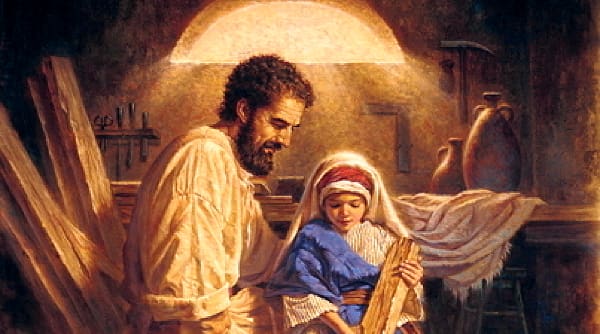
ROME - St. Joseph is the patron saint of retired Pope Benedict XVI - Joseph Ratzinger - but Pope Francis’ devotion to the husband of Mary and guardian of Jesus is clear as well.
In fact, at the beginning of his pontificate in 2013, Pope Francis confirmed a directive that Pope Benedict had made, but which had not gone into effect, to include the name of St. Joseph permanently in the Eucharistic prayers used at most Masses in the Latin rite.
Pope Francis formally inaugurated his papacy on St. Joseph’s feast day, March 19, and he has a spikenard, the flower used as a symbol of St. Joseph, on his coat-of-arms.
And he has popularized statues of St. Joseph sleeping - or, better, dreaming - mentioning on many occasions how he places particularly difficult prayer requests under the statue.
Meeting families in the Philippines in January 2015, he told them, “I have great love for St. Joseph because he is a man of silence and strength. On my table I have an image of St. Joseph sleeping. Even when he is asleep, he is taking care of the church.”
The thing is, he said, sleep and dreams are very important in the few mentions of St. Joseph in the Gospel. An angel comes to him in a dream to tell him not to be afraid to take Mary as his wife; later, an angel comes to him in a dream to tell him to flee to Egypt with Mary and the baby Jesus, because Herod wants to kill the child.
The Italian website Vatican Insider reported that Pope Francis had told one of his aides about the statue early on. “You know,” he reportedly said, “you have to be patient with these carpenters: They tell you they’ll have a piece of furniture finished in a couple of weeks and it ends up taking a month even. But they get the job done and they do it well! You just need to be patient.”
Amid Italy’s nationwide lockdown to stem the spread of the coronavirus, Francis spoke about the importance of St. Joseph during his weekly general audience March 18. He said, “In life, in work, in family, in joy and in sorrow, he always looked for and loved the Lord, earning the praise Scripture offers of being a just and wise man. Always invoke him, especially in difficult times, and entrust your lives to this great saint.”
Francis also invited Catholics, especially in the midst of the COVID-19 pandemic, to put their families “under the loving gaze of St. Joseph, guardian of the Holy Family and of our families.”
The next morning, preaching during his livestreamed Mass, the pope said God chose “a just man, a man of faith” to raise his son on earth.
As a carpenter, the pope said, St. Joseph must have been very precise. “He was able to adjust an angle of wood by millimeters; he knew how to do it. He was able to trim a millimeter off the surface of a piece of wood. Right? He was precise. But he also was able to enter into the mystery that he could not control,” the mystery of God’s plan for his life and, especially, the mystery of his son, who was both human and God.
When Pope Francis formally inaugurated his papacy in 2013, he told the crowd in St. Peter’s Square that “St. Joseph appears as a strong and courageous man, a working man, yet in his heart we see great tenderness, which is not the virtue of the weak, but rather a sign of strength of spirit and a capacity for concern, for compassion, for genuine openness to others, for love.”
St. Joseph responded to God’s call to be the guardian and protector of his son “by being constantly attentive to God, open to the signs of God’s presence and receptive to God’s plans, and not simply his own,” he said.

Monday, October 21, 2019

Philosophy of Origins


by


Damien F. Mackey


God, who lives beyond time, has made everything that is (John 1:1-2):

“In the beginning was the Word, and the Word was with God, and the Word was God. He was with God in the beginning. Through him all things were made; without him nothing was made that has been made”.
 

God created all ex nihilo, “not out of anything”.


God and Creation


Jesus Christ has revealed God as a Trinity of Persons, a Communion or Family of Love.


According to Pope Francis: Christ “has shown us the face of God, One in substance and Triune in Persons; God is all and only Love, in a subsisting relationship that creates, redeems, and sanctifies all: Father, Son, and Holy Spirit.”

The Son of God showed that God first sought us, and revealed that eternal life is precisely “the immeasurable and gratuitous love of the Father that Jesus gave on the Cross, offering his life for our salvation.”

“And this love, by the action of the Holy Spirit, has irradiated a new light upon the earth and in every human heart that welcomes it.”

“May the Virgin Mary help us to enter ever more, with our whole selves, into the trinitarian Communion, to live and bear witness to the love that gives sense to our existence”.


The Holy Family, Jesus (in his humanity), Mary and Joseph, is an icon of the Holy Trinity, Joseph reflecting the Father and Mary (the Immaculate Conception) reflecting the Holy Spirit (the uncreated Immaculate Conception).


God, who lives beyond time, has made everything that is (John 1:1-2): “In the beginning was the Word, and the Word was with God, and the Word was God. He was with God in the beginning. Through him all things were made; without him nothing was made that has been made”.

God created all ex nihilo, “not out of anything”.

Psalm 33:9: “He spoke, and it was.” That is, its existence depended on his Word; the universe sprang into being at his command; he had only to speak, and it arose in all its grandeur where before there was nothing.


I personally do not favour the concept of a Big Bang explosion, but I might be wrong.

Can anything constructive, let alone our glorious cosmos, emerge from an explosion?


Proverbs 8:30 describes Wisdom at play, as beautifully explained here:


This song describes the dynamic of authentic play. Play is not wasting time, but

entering into time with fullness of heart. This reflects rejoicing in the birth of each new day, delighting in how we as God’s children co-create with God, bringing forth a world of beauty.


“Day after day, God’s wisdom at play in the universe,

delighting to be with us, the children of earth”.

Wondrous Wisdom, rejoicing in earth’s birth and rebirth:

majestic mountains, rolling hills, roaring waters, flowing streams.

Playful Wisdom, setting out a table of fine food;

with whole grain bread, full-bodied wine, bountiful banquet blessing with joy.

Creative Wisdom, dancing on the edge of chaos;

divine desire dwells deep within, risking passion, daring us to dream.

Gentle Wisdom, calling out with dawns’ first light;

graceful instruction, creative counsel, whispers of wisdom speak softly to our heart.

Radiant Wisdom, sparkling starlight, flame of love,

resplendent as sunlight at mid-day, fields of wildflowers bright and alive.


“Gentle Wisdom” – hard to reconcile this with a Big Bang!


We need to learn again how, like Wisdom, to make ‘work’, playful, and not a soul-destroying drudge. God’s universe is intimately known to Him, for He “telleth the number of the stars: and calleth them all by their names” (Psalm 146:4, Douay). He rolled out those mighty luminaries like a child playing with marbles, but all done with a sublime teleological purpose (Genesis 1:14), to “serve as signs to mark sacred times, and days and years”.

Nowhere is this fact better exemplified than in Lieutenant-Colonel G. Mackinlay,’s The Magi: How They Recognised Christ's Star (Hodder and Stoughton, 1908), in which the author demonstrates that the heavenly cycles when properly co-ordinated with the life of Jesus Christ reveal a stupendous witness of sun, moon and stars as appropriately marking sacred times.


Those billions of years posited by astronomers and physicists seem to me to be ridiculous and eccentric. Who can reasonably think in terms of such massive numbers?

The solar system is, in my opinion, geocentric.

Anyway, no one can prove this statement to be un-scientific or wrong.


Some qualified scientists, at least, have cast serious doubt upon the supposed ‘vast cosmic ocean of dark energy (matter)’.

According to: http://www.whatreallyhappened.com/WRHARTICLES/bang.php#axzz4k

“Religious circles embraced the idea of an expanding universe because for the universe to be expanding, then at some point in the past it had to originate from a single point, called the “Big Bang”. Indeed, the concept of the Big Bang did not originate with Edwin Hubble himself but was proposed by a Catholic Monk, Georges Lemaître in 1927, two years before Hubble published his observations of the Red Shift.

The “Big Bang” coincided nicely with religious doctrine and just as had been the case with epicycles (and despite the embarrassment thereof) religious institutions sought to encourage this new model of the universe over all others, including the then prevalent “steady state” theory. In 1951 Pope Pius XII declared that Georges Lemaître's work proved the Christian dogma of divine creation of the universe.

Then history repeated itself. Evidence surfaced that the “Big Bang” might not really be a workable theory in the form of General Relativity, and its postulation that super massive objects would have gravity fields so strong that even light could not escape, nor would matter be able to differentiate.

Since the entire universe existing in just one spot would be the most super massive object of all, the universe could not be born”.

The science fiction version of cosmology with which scientists must assail us today - with its great galloping galaxies, cosmic vacuum cleaning Black Holes, microwave cooking radiation and Doppelganger (or is that Doppler?) Effect - seems to be entirely lacking in any sort of cogent Divine plan - the true structure of the universe.


It is all yet awaiting, I believe, a wiser interpretation.


There may well be, for example, a cosmic compatibility between the structure of the universe, on the one hand, and, on the other, the Garden of Eden; the Temple in Jerusalem (patterned on the Garden of Eden); and the Tent of Meeting. In the Book of Hebrews, St. Paul tells us that the Tabernacle, and all its services, were “patterns of things in the heavens” (Hebrews 9:23). The physical objects associated with the earthly sanctuary were “figures of the true” (Hebrews 9:24) — the “shadow of heavenly things” (Hebrews 8:5).


The Garden of Eden was, like the Temple afterwards, a micro-cosmos.


Dr. Ernest L. Martin’s “The Temple Symbolism in Genesis” is well worth reading in this regard. “Each physical item had its spiritual counterpart in Heaven”.


Early Genesis and Toledôt


The Triune God is not affected by time.

Genesis 1 has nothing to do with the time taken by God to create the universe – a ridiculous suggestion! So, Creationists and Evolutionists are free to debate the actual age of the earth.

As some have divined, Genesis 1 is (at least in part) a revelation to man of God’s work of creation. Man - and not God, who never tires nor ceases (Isaiah 40:28) - needs to retire in the evening and then to resume again in the morning.


The Six Days (Hexaëmeron) were real, 24-hour days.


Key to the structure of the Book of Genesis are the eleven colophon divisions, “These are the generations of …”.

Here is an arrangement of it:


  Tablet 
  Starting Verse 
  Ending Verse 
  Owner or  Writer 
 1
 Genesis 1:1
 Genesis 2:4a
  God Himself (?)
 2
 Genesis 2:4b
 Genesis 5:1a
  Adam
 3
 Genesis 5:1b
 Genesis 6:9a
  Noah
 4
 Genesis 6:9b
 Genesis 10:1a
  Shem, Ham & Japheth 
 5
 Genesis 10:1b
 Genesis 11:10a
  Shem
 6
 Genesis 11:10b
 Genesis 11:27a
  Terah
 7
 Genesis 11:27b
 Genesis 25:19a
  Isaac
 8
 Genesis 25:12
 Genesis 25:18
  Ishmael, through Isaac
 9
 Genesis 25:19b
 Genesis 37:2a
  Jacob
 10
 Genesis 36:1
 Genesis 36:43
  Esau, through Jacob
 11
 Genesis 37:2b
 Exodus 1:6
  Jacob’s 12 sons


These “generations” (Hebrew: toledôt) constitute the family histories of the various biblical patriarchs leading up to Moses. These (and not the fragmentary and confusing JEDP sources) are the documents upon which Moses drew to compile what we now call the Book of Genesis, of which he was the editor, but not the author.

The first of these toledôt, concluding Genesis 1, indicates this primary part of Genesis to be a “book” (2:4):

αυτήThis 3588ηis the 976βίβλοςbook 1078γενέσεωςof the origin 3772ουρανούof heaven 2532καιand 1093γηςearth


Moses substantially wrote the remainder of the Pentateuch, as according to tradition.


The Pentateuch would receive further editing, probably by the likes of Samuel, Solomon, Ezra.


Location of Paradise and Eden


Helpful geographical additions provided by editor Moses (Genesis 2:11-14), to elucidate for his contemporaries what had originally been a very simple account of the hydrography presented in Genesis 2 (Adam’s toledôt), enable us to identify the four rivers apparently originating from a single river in Eden. Clearly, the Tigris and Euphrates are the rivers still known today in Mesopotamia, and the Gihon is the circuitous Blue Nile of Ethiopia.

The Pishon, far more disputed, is presumably also towards the west, for reasons of symmetry. Some would place the Pishon in the region of Saudi Arabia.

These four rivers were still flowing many centuries later, in the days of Sirach, who now also included the Nile and the Jordan (Sirach 24:25-27). {Naturally, with the passing of time, and due to catastrophism and severe tectonic activity - for example, the Noachic Flood and the emergence of the Great Rift Valley - the source, courses and capacities of these primeval rivers would have altered significantly}. 

Throughout this ancient riverine system stretched the well-irrigated Paradise.

The Garden of Eden, where ancient Jerusalem would later be situated, was central to Paradise.

That is why Jerusalem is said in the Scriptures to be at “the centre of the earth” (e.g. Ezekiel 38:12). It also explains why Jesus Christ could pin upon the inhabitants of Jerusalem the murder of Abel, by Cain (cf. Genesis 4:8; Luke 11:51), ‘… from the blood of Abel to the blood of Zechariah, who was killed between the altar and the sanctuary’.  


The Creation of Man


Since “… our God is in heaven: He hath done all things whatsoever He would” (Psalm 113:11, Douay), the Triune God could have, had he so wished, created humankind by using an evolutionary process, just as he could have formed the universe through the agency of a Bang.

Pope Pius XII (Humani Generis, 1950) did not entirely discount the possibility of man’s having evolved from a lower form, but with an important qualification:


36. For these reasons the Teaching Authority of the Church does not forbid that, in conformity with the present state of human sciences and sacred theology, research and discussions, on the part of men experienced in both fields, take place with regard to the doctrine of evolution, in as far as it inquires into the origin of the human body as coming from pre-existent and living matter - for the Catholic faith obliges us to hold that souls are immediately created by God. However, this must be done in such a way that the reasons for both opinions, that is, those favorable and those unfavorable to evolution, be weighed and judged with the necessary seriousness, moderation and measure, and provided that all are prepared to submit to the judgment of the Church, to whom Christ has given the mission of interpreting authentically the Sacred Scriptures and of defending the dogmas of faith.


I personally find the theory of evolution to be un-scientific and against common sense.

The most pertinent comment about it, I believe, came from the witty pen of G. K. Chesterton: “The evolutionists seem to know everything about the missing link except the fact that it is missing”. And again: “Anthropologists … have to narrow their minds to the materialistic things that are not notably anthropic. They have to hunt through history and pre-history something which emphatically is not Homo Sapiens, but is always in fact regarded as Simius Insipiens”.


The “Cambrian Explosion”, that sudden appearance in the fossil record of complex animals with mineralized skeletal remains, is one sort of ‘explosion’ that I would accept. And it appears to be disastrous for the theory of evolution, which really likes things to happen very slowly.


Whilst, according to Genesis 1:27, “God created man in his own image, in the image of God created he him; male and female created he them”, the evolutionists promote a bestial origin for humanity. And they pitch back the origins of man with the increasing additions of a zero. Mungo Man (Australia), a relative youngster in the anthropological scheme of things, went from a 60,000 years old estimate to a 40,000 years old estimate in the space of a week.

No one batted an eyelid.


Skeletal remains must be force-fitted into a pre-conceived evolutionary matrix.

Those fine Neanderthals, for instance, have apparently been thus ‘doctored’. Dr. Jack Cuozzo, examining the skull of a ‘teenage Neanderthal’ in Germany, ‘found once again that the replica skull on display was made to look apelike, but a color slide purchased at the museum showed that the lower jaw was dislocated, positioned 30mm out of its socket!  This brought the upper jaw 30mm forward, looking more like a muzzle, and very apelike’.

The Neanderthals, who were physically far superior to us, and who lived much longer than we, were the long-lived antediluvian peoples, some of these also continuing on for a time after the Noachic Flood until this Divine decree was fully realised (Genesis 6:4): “Then the Lord said, ‘My Spirit will not contend with humans forever, for they are mortal; their days will be a hundred and twenty years’.”


A great ‘sin’ of certain scientists today is to imagine that they are fully equipped and entitled to pontificate philosophically and theologically. Most of them are not qualified to do this. Whilst science and technology have brought immense material benefits to our modern world, philosophy itself does not benefit at all from science speak.

We need a return to the pursuit of realism and common sense.


David Collits has well explained it (“Opening up to being – learning to trust ourselves again”):


An air of unreality pervades current day discourse. Focus on identity rights, same-sex ‘marriage’, unisex bathrooms, safe spaces, the mendaciously called ‘Safe Schools’ and so on bespeaks not only a divorce from tradition and custom, but more fundamentally a divorce from reality itself. Something unreal persists in political agitation for a panoply of rights not rooted in human nature or the cosmos itself, and which in fact denies the existence of human nature as such.

Such campaigning is based upon the liberal conceit constitutive of modernity that meaning and identity flows from an ever-expanding assertion of the will and not who we are as human beings. On this view, there is no human nature: I choose, therefore I am. This disconnection from reality is not confined to political issues but permeates our technology-saturated culture. Restoring contact with the real is vital for our culture to convey authentic meaning, as well as how we form our children, use technology and even how we worship.

… the further we are from an unmediated experience of reality, the further we are from God. It is not possible even to think of God philosophically or theologically if one has not first been exposed to the creation that God has put in front of us.

We come to know Being itself through exposure to created being. “The world is charged with the grandeur of God,” so wrote Gerard Manley Hopkins. God, transcendent but immanent to creation, is revealed in the beauty and order of the natural realm perceived in the senses and apprehended in the mind. …. because we are body-soul beings, truth is known to our minds because it is first known to our senses.

Catholicism is not a gnostic religion or philosophy in which knowledge is mediated directly to the mind apart from ‘evil’ matter. Knowledge of God comes first through sensory perception. It is not for nothing that Christ uses parables and lessons based on everyday contact with the earth: the mustard seed and the big tree it becomes, employment in the vineyard, the lilies of the field, the fig tree, the pearl, the field, and so on. Man’s first home was a Garden. The Prince of the Apostles’ occupation was to fish. The Church’s liturgy and sacraments, especially Baptism and the Eucharist, incorporate and elevate basic human and earthly realities: flowing water, bread and wine, oil. Authentic culture arises from liturgical cult fostered on humus, work with the soil that humbles us and can yet be offered to God. Genuine education grows around liturgical cult and is fostered by immersion in the Western canon, whose own roots are in that liturgical culture.

Centuries of rapid technological development, and decades of material wealth and relative peace in the West have inured generations of people to the vicissitudes and hardships that have been the common lot of humanity. Underappreciated perhaps is the negative effect that this material wealth has on the capacity for us to perceive created being and through that God himself. Especially is this acute in the case of the millennial generation, about which much has been written, from issues of housing affordability to its members’ apparent sense of entitlement and ‘flakiness’. ….

Ours is a technological age predicated … on the Modernist idea that reality itself is to be rejected and replaced with artificial constructions of our own, not simply technological but philosophical and ethical as well. The eclipse of religion, gender ideology, and the deconstruction of marriage and the family in the West are the end result of centuries of philosophical and cultural unrealism”.


Metaphysics, which has been replaced by bankrupt modernism and scientism, sorely needs to be revived. But, this time, metaphysics needs to be firmly established upon biblical (Hebrew) foundations, and not as a product of the ancient pagan Greeks.


The Father of Philosophy is God the Father, who created the human mind.

Faith and reason are like two wings on which the human spirit rises to the contemplation of truth; and God has placed in the human heart a desire to know the truth—in a word, to know himself—so that, by knowing and loving God, men and women may also come to the fullness of truth about themselves (cf. Ex 33:18; Ps 27:8-9; 63:2-3; Jn 14:8; 1 Jn 3:2)”, wrote pope John Paul II in his encyclical Fides et Ratio.


The Fall


The real existence of Adam and Eve, and of Noah (and his posterity), though almost universally doubted today (including some church leaders, it seems), may find a scientific ally in science. Do not geneticists refer to the maternal ancestor of all living humans as “Eve”?

The mitochondrial Eve, they call her, to whom our species is robustly and genetically linked.  

The ‘crafty serpent’ in Eden (Genesis 3:1), the Devil, Satan the accuser, the “great, fiery red Dragon” of the Apocalypse (12:3), cunningly masterminded the Fall of Adam and Eve.

Whilst this has been catastrophic for humanity, and for the whole created world, nevertheless, where sin increased, grace abounded all the more” (Roman 5:20). God, as has been famously remarked, is able to take a discordant note (such as the Fall) and write a whole new symphony.

Always a one better than the first.

He may use a ‘rival operation’. Thus the serpent seduced the woman, but now the new Woman, Mary, will crush the serpent’s head.

Saint Louis de Montfort in his Treatise on True Devotion to Mary, wrote of this marvellous cosmic bouleversement:


“God has established only one enmity — but it is an irreconcilable one — which will last and even go on increasing to the end of time. That enmity is between Mary, his worthy Mother, and the devil, between the children and the servants of the Blessed Virgin and the children and followers of Lucifer. Thus the most fearful enemy that God has set up against the devil is Mary, his holy Mother. From the time of the earthly paradise, although she existed then only in his mind, he gave her such a hatred for his accursed enemy, such ingenuity in exposing the wickedness of the ancient serpent and such power to defeat, overthrow and crush this proud rebel, that Satan fears her not only more than angels and men but in a certain sense more than God himself”.

Revelation 12:1-3: “Now a great sign appeared in heaven: a woman clothed with the sun, with the moon under her feet, and on her head a crown of twelve stars. Then being with child, she cried out in labour and in pain to give birth. And another sign appeared in heaven: behold, a great, fiery red dragon having seven heads and ten horns, and seven diadems on his heads”. 


The Triune God, a Family of Love, is the all-seeing Creator.

But, in our age, the Devil is furiously leading a campaign of ‘sin against God’s creation’, particularly against the family. This is the final onslaught.

Such, indeed, was the firm view of Fatima seer, Sister Lucia:


“… the final battle between the Lord and the reign of Satan will be about marriage and the family. Don’t be afraid, she added, because anyone who operates for the sanctity of marriage and the family will always be contended and opposed in every way, because this is the decisive issue”. And then she concluded: “However, Our Lady has already crushed its head”.


Dr. Ernest L. Martin presented a strong case for the Tree of the Knowledge of Good and Evil in the Garden to have been a fig tree – a view supported by tradition. Commenting on Jesus’s somewhat enigmatic and ‘out of season’ cursing of the barren fig tree (Matthew 21:18-22), Martin wrote (Secret of Golgotha, p. 260):


“It [the withered and dead fig tree] signified that NO LONGER would that symbolic tree be in the midst of humanity TO ENCOURAGE MANKIND TO SIN IN THE MANNER OF OUR FIRST PARENTS. But there is even more teaching. It meant that when Christ went to that miraculous tree looking for some figs to eat (like Eve did), CHRIST WOULD NOT FIND ANY WHATSOEVER! This signified that there was NOT going to be a REPETITION of what Eve (and later Adam) did in regard to the fig tree that they partook of. One fig tree [in the Garden of Eden] was the instrument to bring 'sin' into the world, BUT THE SON OF GOD COULD NOT FIND ANY FIGS ON HIS FIG TREE (the miraculous tree on the Mount of Olives that was typical of the Tree of the Knowledge of Good and Evil). Christ cursed THAT symbolic tree at the top of Olivet SO THAT NO MAN WOULD EAT OF IT AGAIN. And to COMPLETE his victory over sin, four days later Christ was going to be SACRIFICED FOR THE SINS OF THE WORLD JUST A FEW YARDS AWAY FROM THIS WITHERED AND DEAD TREE”.


That ‘rival operation’ again: Since Satan had used a tree to engineer the Fall, so would God use a Tree to undo Satan’s work. Galatians 4:4-5: “God sent forth his Son, born of woman, born under the law, to redeem those who were under the law, so that we might receive adoption as sons”. And Colossians 2:13-15:

“When you were dead in your sins and in the uncircumcision of your flesh, God made you alive with Christ. He forgave us all our sins, having cancelled the charge of our legal indebtedness, which stood against us and condemned us; he has taken it away, nailing it to the cross. And having disarmed the powers and authorities, he made a public spectacle of them, triumphing over them by the Cross”.


Christ’s agonising journey to Calvary and to his immolation upon the Cross was, in fact, a triumphal parade, thereby ending the reign of Satan - a foe forever now with ‘a crushed head’.  


Dr. Martin’s interpretation of the fig tree might well explain why Adam and Eve sewed fig leaves together to hide their shame immediately after the fruit-eating incident (Genesis 3:7).

Adam and Eve were no longer permitted to live in the Garden or to have access to the salutary Tree of Life (Genesis 3:24): “After he drove the man out, he placed on the east side of the Garden of Eden cherubim and a flaming sword flashing back and forth to guard the way to the Tree of Life”.

Although Adam and Eve were cast out of the Garden, they still remained in the territory of Eden. It is important to note that the “Garden” and the country of “Eden” were not synonymous.

The Garden was in Eden.


According to some traditions, only Enoch and (later) Melchizedek were ever allowed after that to dwell in the Garden of Eden.