Translate

Thursday, February 21, 2019

Towards a Philosophy that is Christ-shaped


Image result for jesus as teacher


“If philosophy is the love and pursuit of wisdom,
Christian philosophy is the love and pursuit of wisdom
under the authority of Christ, which calls for an ongoing
union with Christ, including one’s belonging to God in Christ”.
 
Paul K. Moser


Paul K. Moser introduces his article, “Toward Christ-Shaped Philosophy”, with this:
A Christian philosophy should incorporate and be guided by the subversive Christian message that the outcast Galilean “Jesus is Lord” (I Cor. 12:3; see Acts 2:36)”.
 
 
In its talk of “Lord” (kurios), this message assigns authority to Jesus Christ, even the authority proper to God (see, for instance, Phil. 2:9-11). The claim that Jesus is Lord figures not only in who counts as a Christian (namely, the one who receives Jesus as Lord), but also in which philosophy counts as Christian (namely, the one that acknowledges Jesus as Lord). A philosophy can be theistic or deistic without being Christian, because it can acknowledge that “God” exists without arming that Jesus is Lord. In this essay I want to clarify the nature of “Christ-shaped” philosophy, distinguishing two senses of “doing Christian philosophy” and identifying the importance of one’s knowing God without reliance on an argument.
 
A Philosopher for Christ
 
Following Jesus, the apostle Paul is the most profound advocate of a Christ-shaped philosophy. Christian philosophy, in his approach, depends on God’s Spirit, and the Spirit in question is Christ-shaped, being the Spirit of Jesus Christ. The Spirit of Christ always points to the volitional struggle of Gethsemane, particularly to the struggling Jesus in Gethsemane, where Calvary was challenged but sealed. In doing so, this Spirit promises to lead us, non-coercively, from death to resurrection life as lasting, reverent companionship with God. This story is Good News, but it rarely gets a serious hearing from philosophers. A key lesson will be that Christ-shaped (or Christian) philosophy should be joined with Christ-formed philosophers.
Paul’s letter to the Colossians oers a striking portrait of Christ-shaped philosophy, but gives a warning: “See to it that no one takes you captive through philosophy . . . and not according to Christ” (Col. 2:8). Paul here contrasts philosophy and Christ. Philosophy outside the authority of Christ, according to Paul, is dangerous to human freedom and life. The alternative is philosophy under Christ, and this involves a distinctive kind of wisdom. If philosophy is the love and pursuit of wisdom, Christian philosophy is the love and pursuit of wisdom under the authority of Christ, which calls for an ongoing union with Christ, including one’s belonging to God in Christ.
Paul illuminates wisdom under Christ. He prays that the Christians at Colossae be filled with “spiritual wisdom [sophia pneumatikē] and understanding, so that you may lead lives worthy of the Lord, fully pleasing to him, as you bear fruit in every good work and as you grow in the knowledge of God” (Col. 1:9-10). “Spiritual wisdom,” in Paul’s approach, is wisdom intentionally guided and empowered by the Spirit of Christ. It therefore yields “lives worthy of the Lord, fully pleasing to him.” No merely theoretical or intellectual wisdom has the power to guide such lives intentionally, and thus Paul refers to spiritual wisdom, which amounts to Spirit-empowered and Spirit-guided wisdom. The redemption of humans calls for an intentional guide or agent who leads and empowers receptive humans inwardly, in accordance with God’s character, even when rules and arguments fall short. Paul reports that he has been commissioned by God to make God’s word fully known, and he identifies God’s word with “the mystery that has been hidden throughout the ages . . . but has now been revealed” (Col. 1:26). Paul speaks of “the riches of the glory of this mystery, which is Christ in you [plural], the hope of glory” (Col. 1:27, my italics). This mystery prompts him to “teach everyone in all wisdom,” in order to “present everyone mature [teleios] in Christ,” being “rooted and built up in him” (Col. 1:28; 2:7). God’s main mystery, according to Paul, “is Christ himself, in whom are hidden all the treasures of wisdom” (Col. 2:2-3).
This inward Christ is alive and interactive with God’s wisdom and power, seeking to renew humans at their deepest place.
Paul oers a cosmic picture: God created all things for (eis) Christ (Col. 1:16), so that Christ might be pre-eminent in everything (Col. 1:18). If Christ is to be pre-eminent in everything, then he should be pre-eminent in philosophy and in every other academic discipline, too. In Paul’s grand portrait, God wants “everyone [to be] mature [or complete] in Christ.” Accordingly, God wants everyone, even every philosopher, to cooperate reverently with the authority of Christ, and this is not a merely external or juridical authority. Instead, the authority seeking maturity in Christ aims for a mysterious inward union (or communion) between the exalted Christ and the people yielding and belonging to him as Lord. This inward union stems from God’s aim that all people become Christ-like in moral and spiritual character, anchored in reverent companionship with God as Father. It demands that one be an intentional agent who freely appropriates the life-giving power of Christ as Lord. ….


Sunday, January 20, 2019

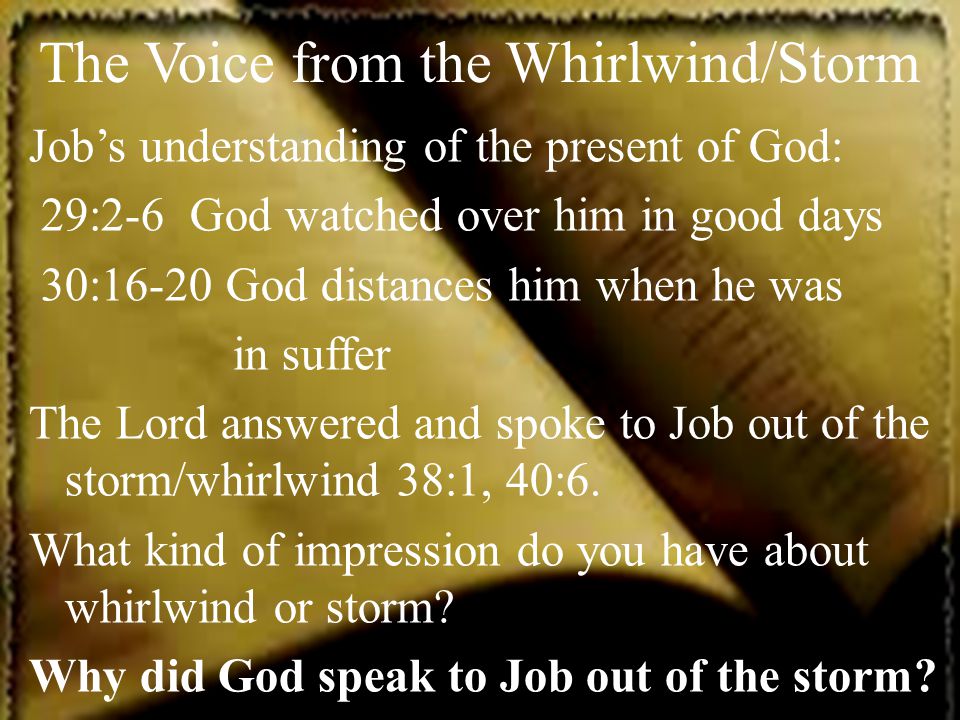
The Lord tells Job of his creation


Image result for why did god speak to job out of the storm


Job 38


The Lord Speaks


38 Then the Lord spoke to Job out of the storm. He said:
“Who is this that obscures my plans
    with words without knowledge?
Brace yourself like a man;
    I will question you,
    and you shall answer me.
“Where were you when I laid the earth’s foundation?
    Tell me, if you understand.
Who marked off its dimensions? Surely you know!
    Who stretched a measuring line across it?
On what were its footings set,
    or who laid its cornerstone
while the morning stars sang together
    and all the angels[a] shouted for joy?
“Who shut up the sea behind doors
    when it burst forth from the womb,
when I made the clouds its garment
    and wrapped it in thick darkness,
10 when I fixed limits for it
    and set its doors and bars in place,
11 when I said, ‘This far you may come and no farther;
    here is where your proud waves halt’?
12 “Have you ever given orders to the morning,
    or shown the dawn its place,
13 that it might take the earth by the edges
    and shake the wicked out of it?
14 The earth takes shape like clay under a seal;
    its features stand out like those of a garment.
15 The wicked are denied their light,
    and their upraised arm is broken.
16 “Have you journeyed to the springs of the sea
    or walked in the recesses of the deep?
17 Have the gates of death been shown to you?
    Have you seen the gates of the deepest darkness?
18 Have you comprehended the vast expanses of the earth?
    Tell me, if you know all this.
19 “What is the way to the abode of light?
    And where does darkness reside?
20 Can you take them to their places?
    Do you know the paths to their dwellings?
21 Surely you know, for you were already born!
    You have lived so many years!
22 “Have you entered the storehouses of the snow
    or seen the storehouses of the hail,
23 which I reserve for times of trouble,
    for days of war and battle?
24 What is the way to the place where the lightning is dispersed,
    or the place where the east winds are scattered over the earth?
25 Who cuts a channel for the torrents of rain,
    and a path for the thunderstorm,
26 to water a land where no one lives,
    an uninhabited desert,
27 to satisfy a desolate wasteland
    and make it sprout with grass?
28 Does the rain have a father?
    Who fathers the drops of dew?
29 From whose womb comes the ice?
    Who gives birth to the frost from the heavens
30 when the waters become hard as stone,
    when the surface of the deep is frozen?
31 “Can you bind the chains[b] of the Pleiades?
    Can you loosen Orion’s belt?
32 Can you bring forth the constellations in their seasons[c]
    or lead out the Bear[d] with its cubs?
33 Do you know the laws of the heavens?
    Can you set up God’s[e] dominion over the earth?
34 “Can you raise your voice to the clouds
    and cover yourself with a flood of water?
35 Do you send the lightning bolts on their way?
    Do they report to you, ‘Here we are’?
36 Who gives the ibis wisdom[f]
    or gives the rooster understanding?[g]
37 Who has the wisdom to count the clouds?
    Who can tip over the water jars of the heavens
38 when the dust becomes hard
    and the clods of earth stick together?
39 “Do you hunt the prey for the lioness
    and satisfy the hunger of the lions
40 when they crouch in their dens
    or lie in wait in a thicket?
41 Who provides food for the raven
    when its young cry out to God
    and wander about for lack of food?

Wednesday, January 16, 2019

Pope Francis at Baptism Mass: ‘Faith is transmitted in the home’


Pope Francis baptises a newborn baby on the Solemnity of the Baptism of the Lord. Image: Vatican Media/Vatican News.


During Mass on the Solemnity of the Baptism of Our Lord, Pope Francis baptises 27 newborn babies, and invites parents to transmit the faith to their children within the home.
Speaking to parents in his homily on Sunday, the Holy Father reflected on the parental duty of transmitting the faith to the next generation.


“You have asked the Church for faith for your children, and today they will receive the Holy Spirit and the gift of faith in each one’s heart and soul.”
But, Pope Francis said, “this faith must be developed; it must grow.”


Transmit faith at home
Before children study the faith in catechism classes, he said, their parents must transmit it at home, “because the faith is always transmitted ‘in dialect’,” that is, the native language spoken in the environs of the home.


The Pope said parents transmit the faith through their example and words, and by teaching their children to make the Sign of the Cross.
He said the faith must be transmitted “with your faith-filled lives”, so children see married love and peace within the family home. “May they see Jesus there.”


Don’t fight in front of children
Then Pope Francis gave parents a word of advice.
“Never fight in front of your children,” he said. “It’s normal that parents should argue; the opposite would be strange. Do it, but without letting them hear or see.”
“You have no idea the anguish it causes a child to see his or her parents fight.”


He said this was a word of advice “that will help you to transmit the faith.”


Get comfortable
Finally, Pope Francis invited the parents present at the ceremony to make their children comfortable, and to breastfeed them if they were hungry.
“To you mothers I say: Breastfeed your children, don’t worry. The Lord wants this.”


With thanks to Vatican News and Devin Watkins, where this article originally appeared.


https://catholicoutlook.org/pope-francis-at-baptism-mass-faith-is-transmitted-in-the-home/

Thursday, January 10, 2019

In the Pope Francis era, the Eucharist defines doctrinal tussles


ROME - Famously, Pope Francis isn’t one for spending a lot of time thinking about doctrinal questions or disputes.
The pontiff often mocks theologians for obsessing over the fine print of things, recycling a quote from Patriarch Athenagoras of Constantinople to Pope Paul VI after an historic 1964 meeting: “We’ll bring about unity between us, and then we’ll put all the theologians on an island so they can think about it!”
Try as Francis might, however, he can’t make doctrinal tussles in Catholicism completely disappear, because Christianity is what’s known as a “creedal” religion, meaning one in which belief matters. In reality, each of the past three years of his papacy has been marked by a defining doctrinal debate, and 2019 may turn out to be more of the same.
The fascinating point about those debates is that each, in one way or another, has centered on the Eucharist - suggesting that in the Pope Francis era, Eucharistic theology may be the defining doctrinal divide.
Of Francis’s personal faith in the Eucharist, there can be no question.
During a general audience in November 2017, for instance, Francis referred to every celebration of the Mass as “a ray of light of the unsetting sun that is the Risen Jesus Christ.” In June 2018, on the traditional Catholic feast of Corpus Christi, Francis said that only the Body and Blood of Jesus Christ, the food of life, can satisfy the hunger of hearts for love.
In August last year, Francis called communion a foretaste of heaven.
“Every time that we participate in the Holy Mass, we hasten heaven on earth in a certain sense because from the Eucharistic food - the body and blood of Christ - we learn what eternal life is,” he said.
Yet despite that ardent Eucharistic emphasis, critics say that Francis has endangered traditional Catholic beliefs about the sacrament.
When the pope issued his document Amoris Laetitia in 2016, it opened a ferocious internal argument over his cautious opening to allowing Catholics who divorce and remarry outside the Church to receive Communion. Although that decision touched on the theology of marriage and other matters, at its core was the question of what the Eucharist is and what the proper conditions are for someone to receive it.
Francis and his advisors insisted that the decision in Amoris didn’t involve any revision at all to Church teaching, while critics lambasted it as a fairly radical repudiation of what had come before. In any event, the point is that disagreements over how to understand the Eucharist were at the heart of the Amoris debates.
In a similar fashion, 2018’s major doctrinal row was centered in Germany, where roughly a two-thirds majority of the country’s bishops favored a set of guidelines opening Communion to the Protestant spouses of baptized Catholics under at least some circumstances.
While a handful of German prelates objected, forcing a Vatican meeting on the subject, Francis essentially left the decision to the discretion of the conference and its members, with the result that there is no uniform national standard right now.
That debate, too, was about the nature of the Eucharist, in part because it raised the question of what it means to be in “communion” with the Catholic faith in especially acute form.
Although 2019 just began, it’s possible that this year’s signature doctrinal controversy could also center on the Eucharist.
Rumors are currently making the rounds that Francis may be getting ready for an ecumenical Communion service with Protestants, in particular Lutherans, the details of which have been entrusted to an informal working group. The idea is that despite whatever nuances may separate Lutheran and Catholic understandings of the Eucharist, they would be judged insufficiently serious to prevent mutual reception of the sacrament, at least under certain circumstances.
Such rumors, by the way, have circulated since Francis traveled to Sweden in October of 2016 to mark the 500th anniversary of the Protestant Reformation, and they may very well be inaccurate or exaggerated. Yet the very fact they circulate at all is revealing, in part because of what that says about people’s perceptions of this pope’s approach to Eucharistic topics.
Why has the Eucharist become the front-and-center doctrinal flashpoint of the Pope Francis era?
Part of the explanation may be that Francis inherited a series of question marks about the Eucharist and was compelled to answer them. In that sense, it may be less a matter of personal choice than the agenda any pope would have been compelled to face.
On the other hand, faith in the Eucharist as the real presence of Christ traditionally has been a cornerstone of Catholic identity, a conviction that sets Catholics apart. Under a pope who seems determined to play down such distinctions in order to emphasize commonalities, perhaps it’s no real surprise that competing visions of the Eucharist, and especially who’s eligible for it, have risen to the surface.
However much Francis may poke fun from time to time at the obtuseness or pedantry of theologians, doctrine is part of the lifeblood of the Catholic Church - and in his era, those theologians seem to have plenty to talk about, beginning with what this pope is teaching in both word and deed about the central sacrament of the faith.


https://cruxnow.com/news-analysis/2019/01/10/in-the-pope-francis-era-the-eucharist-defines-doctrinal-tussles/

Sunday, January 6, 2019

Pope says that despite shadows, Church reflects light of Christ


Elise Harris
Jan 6, 2019
  

ROME - Marking the Catholic feast of the Epiphany, when, according to the Bible, the three Magi - also called the three wise men or the three kings - found the infant Jesus and brought him gifts after following a star, Pope Francis on Sunday urged Catholics to imitate them in seeking the light of Christ, not that of the world.

When looking at the list of influential leaders at the time of Jesus’ birth such as Tiberius Caesar, Pontius Pilate, King Herod and the high priests Annas and Caiaphas, it might be tempting “to turn the spotlight on them,” the pope said in his Jan. 6 homily for the Epiphany.

However, the word of God came “to none of the magnates, but to a man who had withdrawn to the desert,” he said, referring to John the Baptist. The surprise in this, Francis added, is that “God does not need the spotlights of the world to make himself known.”
“God’s light does not shine on those who shine with their own light,” he said, adding that “it is always very tempting to confuse God’s light with the lights of the world. How many times have we pursued the seductive lights of power and celebrity, convinced that we are rendering good service to the Gospel! But by doing so, have we not turned the spotlight on the wrong place, because God was not there.”

Rather than making a scene, God’s light is manifested in humble love, he said, noting that the Church itself has also at times “attempted to shine with our own light.”
“We are not the sun of humanity. We are the moon that, despite its shadows, reflects the true light, which is the Lord. He is the light of the world. Him, not us,” the pope said. Pointing to the day’s first reading from Isaiah, he said God’s light “does not prevent the darkness and the thick clouds from covering the earth, but shines forth on those prepared to accept it.”

Pope Francis said that like the Magi, who, after visiting Jesus “left by another road” in order to avoid passing by Herod, who wanted to kill the infant Jesus, Christians must choose to follow another path than the one offered by the world.
“In order to find Jesus, we also need to take a different route, to follow a different path, his path, the path of humble love. And we have to persevere,” he said, noting how the Magi left their home and “became pilgrims on the paths of God. For only those who leave behind their worldly attachments and undertake a journey find the mystery of God.”

Francis stressed that it is not enough to simply know that Jesus was born or where he was born, but a personal encounter such as the one the Magi had is needed in order to grow close to him. Christians, he said, must imitate the Magi, who did not argue or debate, but immediately set out without looking back to find Jesus and to be with him.
“They do not stop to look, but enter the house of Jesus. They do not put themselves at the center, but bow down before the One who is the center. They do not remain glued to their plans, but are prepared to take other routes,” he said, adding that the Magi had a “radical openness” and a “total engagement” with God reflected in the fact that they did not come to ask for anything, but brought gifts of their own.
“Let us ask ourselves this question: at Christmas did we bring gifts to Jesus for his party, or did we only exchange gifts among ourselves?” Francis asked, and reflected on the meaning of the gifts of gold, frankincense and myrrh the Magi brought to Jesus.

Gold, he said, serves as a reminder that God has to be first place in a person’s life, and that he must be worshiped. To do this, he said, it is necessary “to remove ourselves from the first place and to recognize our neediness, the fact that we are not self-sufficient.”Frankincense, a fragrant resin used in incense and perfumes, is a symbol of prayer and relationship with God. Like incense, which must be burned to release its fragrance, Catholics must “burn a little of our time” in prayer with God, “not just in words, but also by our actions,” he said.
On myrrh, a fragrant oil, the pope said noted how at Jesus’ death it was the ointment used to wrap his body when it was taken down from the cross.

The Lord, he said, “is pleased when we care for bodies racked by suffering, the flesh of the vulnerable, of those left behind, of those who can only receive without being able to give anything material in return. Precious in the eyes of God is mercy shown to those who have nothing to give back. Gratuitousness!”
With just a week left in the liturgical season of Christmas, which ends next Sunday with the feast of the Baptism of the Lord, Pope Francis urged faithful not to mist the opportunity “to offer a precious gift to our King, who came to us not in worldly pomp, but in the luminous poverty of Bethlehem. If we can do this, his light will shine upon us.”

The pope’s Christmas season comes to a close this week with his annual speech to diplomats on Monday and next Sunday’s baptism of newborns for Vatican employees, held in the Sistine Chapel.

https://cruxnow.com/vatican/2019/01/06/pope-says-that-despite-shadows-church-reflects-light-of-christ/


Sunday, December 30, 2018

Pope reflects on Holy Family at Sunday Angelus


On the feast of the Holy Family, Pope Francis focuses on the "astonishment" and "anxiety" of Mary and Joseph in his reflection on the day's Gospel.

By Christopher Wells

The Holy Family of Nazareth – Jesus, Mary, and Joseph – were “united by an intense love and animated by great confidence in God,” Pope Francis said on Sunday.
Speaking at the weekly recitation of the Angelus, the Holy Father recalled that the Sunday within the Octave of Christmas is the feast of the Holy Family. The day’s Gospel recounts the story of the finding of Jesus in the Temple. The Holy Family had gone to Jerusalem to celebrate the Passover; but on the return voyage, Mary and Joseph discovered that Jesus, who was only twelve years old, was not in the caravan. They searched for Jesus for three days, finally finding Him in the Temple amid the doctors of the law. When they found Jesus, the Gospel says, “they were astonished”; and Mary expressed her concern to Jesus, saying, “Your father and I have been looking for you with great anxiety.”

Astonishment never failed

Pope Francis focused on these two feelings of “astonishment” and “anxiety” in his reflection at the Angelus. In the Holy Family, he said, astonishment “never failed.” To feel astonishment, he said, “is the opposite of taking everything for granted… It means opening ourselves to others.” This attitude, he said, is important for “healing compromised relationships” and curing “the open wounds within the family.”

Holy Family centred on Jesus

The “anxiety” felt by Mary and Joseph “shows the centrality of Jesus in the Holy Family,” Pope Francis explained. And so, he said, “we see why the family of Nazareth is holy: because it was centred on Jesus; all the attention and care of Joseph revolved around Him.”
Pope Francis said the anxiety felt by Mary and Joseph when Jesus was lost for three days “should also be our anxiety when we are far from Jesus; when we forget Jesus, going without prayer, without reading the Gospel for several days. Mary and Joseph, he said, found Jesus in the Temple; and we too, should seek Jesus in the house of God – and especially in the liturgy, where we have the living experience of Jesus, in His Word and in the Eucharist, “from which we receive the strength to face the difficulties of each day.”

Praying for all families

The Holy Father concluded his reflection by asking everyone “to pray for all the families of the world, especially those that, for various reasons, are lacking in peace and harmony” and to “entrust them to the protection of the Holy Family of Nazareth.”

https://www.vaticannews.va/en/pope/news/2018-12/pope-reflects-on-holy-family-at-sunday-angelus.html


Thursday, December 20, 2018

Pope Francis says “Welcome the surprises of Heaven this Christmas!”


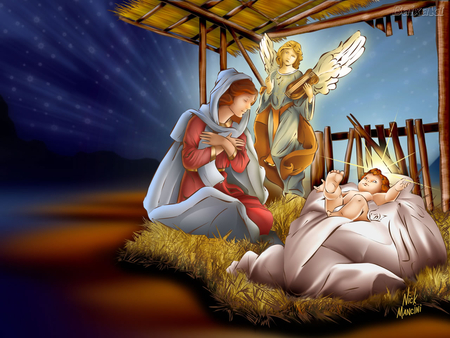
Jesus's birth - nativity, christ, jesus, christianity, christmas, religion, god

Pope Francis has encouraged all to look out for the surprises that Christmas brings

The Blessed Virgin Mary was surprised by the Angel Gabriel at the Annunciation and Joseph was surprised by the angel in his dream, which told him to take Mary as his wife.


“But it is on the night of Christmas that the biggest surprise comes: The Most High is a small child,” he said. “To celebrate Christmas, then, is to welcome the surprises of Heaven on earth.”


Speaking at his weekly general audience, Pope Francis reflected on the surprising elements of Christ’s birth, and the way each Catholic can replicate the feelings at the first Christmas in his or her heart by making room for silence.


“Christmas is preferring the silent voice of God to the noisiness of consumerism. If we can be silent in front of the crib, Christmas will be a surprise even for us, not something seen before,” he said.
“Be silent in front of the nativity,” he advised. “This is an invitation for Christmas, take some time. Go before the nativity and stay in silence.”


The daily Gospels in Advent warn against becoming weighed down by the “anxieties of daily life.” “These days we rush, maybe as we never have during the year. But this is the opposite of what Jesus wants,” he said.


Pope Francis, even though his time will be filled with events, will deliberately give ‘space to silence’, just as he recommends others do.


We will celebrate Christmas well, “if, like Joseph, we will give space to silence; if, like Mary, we say ‘here I am’ to God; if, like Jesus, we will be close to those who are alone; if, like the shepherds, we will leave our enclosures to be with Jesus,” Pope Francis said.


“It will be Christmas, if we find the light in the poor cave of Bethlehem.”


http://mnnews.today/church/2018/pope-francis-says-welcome-the-surprises-of-heaven-this-christmas/