Translate

Friday, January 26, 2018

Serpent in Garden first bringer of "fake news": Pope Francis

EveSnake


By Jason Horowitz


Rome: The serpent in the Garden of Eden hissed the first fake news to Eve and it all went downhill from there, Pope Francis writes in a major document about the phenomenon of fake news released on Wednesday.
"We need to unmask what could be called the 'snake-tactics' used by those who disguise themselves in order to strike at any time and place," the pope writes in a message ahead of what the church has designated as its World Day of Social Communications, in May.

Arguing that the "crafty" serpent's effective disinformation campaign to get Eve to eat from the tree of knowledge "began the tragic history of human sin," he adds, "I would like to contribute to our shared commitment to stemming the spread of fake news."
Pope Francis has worn many hats since his election in 2013 — Vatican reformer; global advocate for refugees, the poor, and world peace; and, more recently, defender of bishops accused of covering up for pedophile priests.
But in a varyingly sophisticated, spiritual and questionable analysis of the fake news epidemic, the 81-year-old pontiff tried on the cap of contemporary media critic to address an issue that has wreaked havoc and undermined democracies from the United States to Europe and beyond.

In doing so, he offered a largely cleareyed assessment of the problem, its social impact, and the responsibility of social media giants and journalists. And he called on news consumers to break out of their comfortable echo chambers and cushy news feeds by seeking out different points of view.
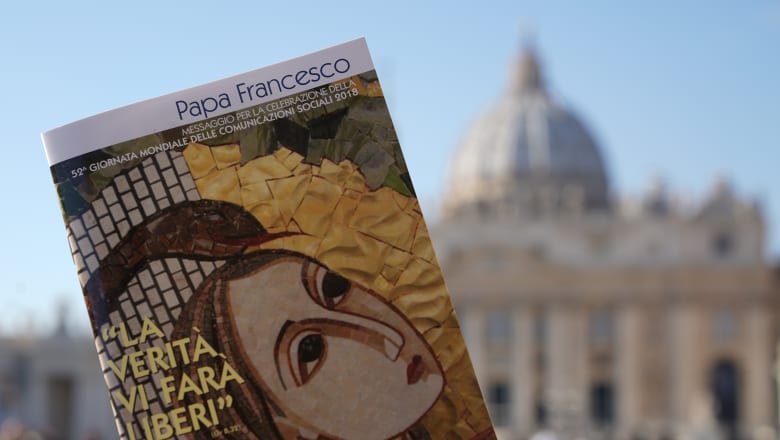
Pope Francis' book on "Fake News" in front of St Peter's Basilica in Rome.
Photo: AP
But at times the pope also conflated fake news, which is politically or economically motivated disinformation, with an incremental and sensational style of journalism he dislikes — a muddying of the waters that many democracy advocates have worried is corrosive to a free press and to the ideal of an informed populace.
He also failed to mention the political leaders who have used the phrase to discredit journalists and to dismiss inconvenient reporting.
Betraying a somewhat antiquated view that separates dead-tree and digital outlets, the pope defined fake news as the spreading "online or in the traditional media" of disinformation that is intended to deceive and manipulate consumers for political and economic interests.

He observed that fake news is effective because, like the snake in the garden, it insidiously mimics real news, and is "captious"— pope for clickbait — meaning that it grabs people's attention by exploiting "emotions like anxiety, contempt, anger and frustration."
Francis identified social networks as the delivery systems for such fake news.
"Untrue stories can spread so quickly that even authoritative denials fail to contain the damage," he writes, adding that those living virtual lives in like-minded silos allow disinformation to thrive and that the absence of opposing viewpoints turns people into "unwilling accomplices in spreading biased and baseless ideas."
Russian hackers took advantage of just such conditions in the 2016 American elections, sowing discord and attempting to sway the electorate through sophisticated influence campaigns. Francis steered clear of such real-world examples. Instead, he broadly identified greed as a key engine for the spread of fake news.
"Fake news often goes viral, spreading so fast that it is hard to stop, not because of the sense of sharing that inspires the social media, but because it appeals to the insatiable greed so easily aroused in human beings," he wrote.

The results, he says, are soul-killing.
Turning to the "The Brothers Karamazov," he quotes Dostoyevsky: "People who lie to themselves and listen to their own lie come to such a pass that they cannot distinguish the truth within them, or around them, and so lose all respect for themselves and for others." This leads to the coarsening of society, Francis says.
To combat fake news, the pope called for personal efforts to unmask disinformation, but he also praised educational programs, regulatory efforts and social media companies' progress in verifying personal identities "concealed behind millions of digital profiles."
In recent years, the European Union and several European countries have established offices to combat fake news — this week, Britain became the latest. And fake news has emerged as a major theme in the Italian elections scheduled for March 4, and it is often discussed in the Italian news media that imbues the Vatican.
The speaker of the lower house of the Italian Parliament, Laura Boldrini, has backed a program in Italian public schools to teach children how to identify fake news. The government announced this month an online service through the country's postal police that would respond to, and assess, accusations of fake news.

Likewise, Matteo Renzi, the leader of Italy's governing Democratic Party, has pressed Facebook to monitor its platform for fake news. Facebook has said it would dispatch a task force to address the problem before the Italian election.
Globally, Facebook's more consequential contribution may be a major policy change announced this month: It plans to step back from its de facto role as the world's news publisher. In the United States, more lawmakers are interested in regulating social media giants as they do traditional television broadcasters.
But the pope argues that the most "radical antidote" to the scourge of fake news lies in "purification by the truth." In Christianity, he said, that means living the truth through faith in Jesus, who, he observed, said, "I am the truth" and "the truth will set you free."
Along those lines, he argued that the marshaling of undeniable facts to hurt and discredit others "is not truthful." Nor is any statement that provokes quarrels, division or resignation, he says. The truth, in the pope's reading, leads to dialogue and "fruitful results."
To achieve a climate of open-minded dialogue, Francis exalted journalists, who have been generally demonized by President Trump and other leaders in efforts to undercut critical coverage. The pope called them the "protectors of news" and characterised their profession as a "mission."

"Informing others means forming others; it means being in touch with people's lives," he wrote. "That is why ensuring the accuracy of sources and protecting communication are real means of promoting goodness, generating trust, and opening the way to communion and peace."
That message — and his appeal to cover the powerless, voiceless and downtrodden — could be found in many a Journalism 101 class. Less so his distaste for the "mad rush for a scoop" and focus on "audience impact" and "breaking news."
Also, the value on revelations that the pope seems to think is overemphasised is what many journalists would argue is the greatest service the profession can provide to the powerless, as in the case of Vatican sex abuse and financial scandals.
As the pope sees it, journalists less focused on scoops, news consumers more open to other views, and social media companies and officials more committed to safeguarding the web would open eyes to mimicry — what Francis called "that sly and dangerous form of seduction that worms its way into the heart with false and alluring arguments"— and thus cast that original and slithering bearer of fake news from the garden.

....
Taken from: https://www.brisbanetimes.com.au/world/europe/pope-francis-lays-out-moral-case-against-fake-news-propaganda-20180125-p4yyuk.html

Monday, January 8, 2018

Darwin’s Mistake


Image result for darwin's mistake


“Why do we find dinosaur skeletons on all continents so close to the ground surface that,

in some cases, the bones simply jut out of the ground?”
 

Dr. Hans Zillmer


In this book, Dr. Hans Zillmer poses a series of fascinating - and most reasonable - questions:  http://www.zillmer.com/!english/e_buecher/darwinsmistake.html


DARWIN´S MISTAKE -
Antediluvian findings prove dinosaurs and humans lived simultaneously in coexistence


Was there an evolution? How old is the Earth really?


Everything seems proven: Earth is some billion years old. Scientific methods determine the ages of things. Geologists confirm the slow growth of rock strata and earth layers. Biologists prove that human beings gradually developed from protozoa to humanity. Both sciences substantiate each other’s theories. Are they one-legged men, one supporting the other? Or is the evidence they bring forth really secured?


If all things are exactly proven and explored, then we should ask ourselves, why we take certain phenomena for granted that we still are not able to explain. Why do we find dinosaur skeletons on all continents so close to the ground surface that, in some cases, the bones simply jut out of the ground? How come whole nests of eggs survived without signs of decay, and why were they not eaten by other animals? We simply accept that we make these findings after more than 64 million years – incredible findings, however, if we apply to them, what we know of history and the enormous time that has elapsed. Let alone that science is unable to explain, how petrifaction can take place on the surface at all. By merely lying around long enough? If so, then we should be able to observe this tendency towards surface petrifaction today. Why has no such process been documented?


Not only at the Paluxy River in Texas but in other parts of the world as well, traces of dinosaurs, trilobites, mammals, and humans were found together. The Theory of Evolution chronologically allocates the lifetimes of these living beings to ages hundreds of millions of years apart. The author personally partook in excavations proving the temporal coexistence of all of these life forms. He also proves: There was no evolution. It is merely a fictitious working model.


There have always been doubts about our view of the world. Great mysteries to some extent form our normality. For example: How did the ice ages come about? How did the rusty piece of a bicycle get into layers formed during the last ice age? Where did the gigantic belt of loess come from that stretches from France all the way to distant China? Why was the Antarctic ice-free in a more recent past, as ancient charts show? Why did the continents drift apart when dinosaurs still existed? How come we find so many tools and technical aids in age-old geological strata of rock? How is it possible that we are able to admire a 4500 year old Akkadian rolled seal at Berlin’s »Middle Eastern Museum« that displays all planets of our solar system, if only five of them are visible to the bare eye?


Many questions to which this book gives detailed answers. For the first time, a book presents a comprehensive, unquestioningly conclusive concept of the earth’s past.


Polish Professor prefers Devolution to Evolution


Image result for giertych book devolution


Prof. Giertych showed that population genetics failed to explain the formation of races

through mutations and neo-Darwinian selection”.


Professor Maciej Giertych’s book is reviewed as follows at:


Evolution, Devolution, Science

Professor Maciej Giertych

BA, MA(Oxon), PhD, DSc.

Coloured paperback - 184pp

Now available in English.
 

Just ten years ago (11th October, 2006), when Professor Giertych was a Member of the European Parliament, he organised a conference in Brussels on the teaching of evolution in European schools. The main speakers provided arguments from their specialist fields of expertise that the evidence of natural sciences showed devolution rather than evolution.
 

Prof. Giertych showed that population genetics failed to explain the formation of races through mutations and neo-Darwinian selection.
 

Dr Hans Zillmer [German palaeontologist] demonstrated the lack of fossil evidence for evolution, and for the co-existence of dinosaurs and humans.
 

Dr Guy Berthault [French sedimentologist] presented research studies from his work with Prof. Pierre Julien at Colorado State University that proved that the formation of geological strata occurs rapidly - millions of years are not needed.


Prof. Joseph Mastropaolo [human physiologist Irom California State University] argued that the trend of geometric increase in genetic diseases resulting from mutations demonstrated the opposite direction to evolution.
 

This book expands on these presentations to include chapters on the scientific opposition to evolution, its implications for ethics and world religions, and the teaching of Catholic Church [3pp]. The sections on mutations, sedimentology, Nobel Prize winners, eugenics, and extinction are particularly well developed.

 
Beautifully illustrated - unique in style and content. Brilliant! [Ed.]
 

'Devolution - a branch of science that, in contrast to evolution the direct effects of which we cannot see, observes a continuous extinction of species and information resources of the biosphere [the regions of land, sea and atmosphere occupied by life].


Erik Verlinde’s case against dark matter


In a new paper, Erik Verlinde of the University of Amsterdam argues that dark matter is an illusion caused by the holographic emergence of space-time from quantum entanglement.


“In his calculations, Verlinde rediscovered the equations of “modified Newtonian dynamics,” or MOND. This 30-year-old theory makes an ad hoc tweak to the famous “inverse-square” law of gravity in Newton’s and Einstein’s theories in order to explain some of the phenomena attributed to dark matter.”

Natalie Wolchover


Natalie Wolchover dramatically introduces Erik Verlinde as:  
 

The Man Who's Trying to Kill Dark Matter


She writes:
 

For 80 years, scientists have puzzled over the way galaxies and other cosmic structures appear to gravitate toward something they cannot see. This hypothetical “dark matter” seems to outweigh all visible matter by a startling ratio of five to one, suggesting that we barely know our own universe. Thousands of physicists are doggedly searching for these invisible particles.


But the dark matter hypothesis assumes scientists know how matter in the sky ought to move in the first place. At the end of 2016, a series of developments has revived a long-disfavored argument that dark matter doesn’t exist after all. In this view, no missing matter is needed to explain the errant motions of the heavenly bodies; rather, on cosmic scales, gravity itself works in a different way than either Isaac Newton or Albert Einstein predicted.


The latest attempt to explain away dark matter is a much-discussed proposal by Erik Verlinde, a theoretical physicist at the University of Amsterdam who is known for bold and prescient, if sometimes imperfect, ideas. In a dense 51-page paper posted online on Nov. 7, Verlinde casts gravity as a byproduct of quantum interactions and suggests that the extra gravity attributed to dark matter is an effect of “dark energy”—the background energy woven into the space-time fabric of the universe.


Instead of hordes of invisible particles, “dark matter is an interplay between ordinary matter and dark energy,” Verlinde said.


To make his case, Verlinde has adopted a radical perspective on the origin of gravity that is currently in vogue among leading theoretical physicists. Einstein defined gravity as the effect of curves in space-time created by the presence of matter. According to the new approach, gravity is an emergent phenomenon. Space-time and the matter within it are treated as a hologram that arises from an underlying network of quantum bits (called “qubits”), much as the three-dimensional environment of a computer game is encoded in classical bits on a silicon chip. Working within this framework, Verlinde traces dark energy to a property of these underlying qubits that supposedly encode the universe. On large scales in the hologram, he argues, dark energy interacts with matter in just the right way to create the illusion of dark matter.


In his calculations, Verlinde rediscovered the equations of “modified Newtonian dynamics,” or MOND. This 30-year-old theory makes an ad hoc tweak to the famous “inverse-square” law of gravity in Newton’s and Einstein’s theories in order to explain some of the phenomena attributed to dark matter. That this ugly fix works at all has long puzzled physicists. “I have a way of understanding the MOND success from a more fundamental perspective,” Verlinde said.


Many experts have called Verlinde’s paper compelling but hard to follow. While it remains to be seen whether his arguments will hold up to scrutiny, the timing is fortuitous. In a new analysis of galaxies published on Nov. 9 in Physical Review Letters, three astrophysicists led by Stacy McGaugh of Case Western Reserve University in Cleveland, Ohio, have strengthened MOND’s case against dark matter.


The researchers analyzed a diverse set of 153 galaxies, and for each one they compared the rotation speed of visible matter at any given distance from the galaxy’s center with the amount of visible matter contained within that galactic radius. Remarkably, these two variables were tightly linked in all the galaxies by a universal law, dubbed the “radial acceleration relation.” This makes perfect sense in the MOND paradigm, since visible matter is the exclusive source of the gravity driving the galaxy’s rotation (even if that gravity does not take the form prescribed by Newton or Einstein). With such a tight relationship between gravity felt by visible matter and gravity given by visible matter, there would seem to be no room, or need, for dark matter.


….

Van Raamsdonk calls Verlinde’s idea “definitely an important direction.” But he says it’s too soon to tell whether everything in the paper—which draws from quantum information theory, thermodynamics, condensed matter physics, holography and astrophysics—hangs together. Either way, Van Raamsdonk said, “I do find the premise interesting, and feel like the effort to understand whether something like that could be right could be enlightening.” ….


Monday, October 9, 2017

Pope Francis: The Good Samaritan manifests the mystery of Christ


Good Samaritan


Pope Francis preaching a homily at Mass
in the chapel of Santa Marta in the Vatican, Oct 9, 2017.


(Vatican Radio)  Pope Francis on Monday urged Christians to emulate the figure of the Good Samaritan and help those in need to get up, like Christ who “continues to pay” for us.   Delivering a homily at the morning Mass at the Casa Santa Marta residence in the Vatican, he reflected on the attitude of the various actors in the parable of the Good Samaritan in Luke’s Gospel, which, he said, was an answer to the doctor of the Law on who his neighbour was.
Actors in the parable 
Commenting on the robbers, the priest who is “a man of God”, and the Levite who is “close to the law”, all of whom passed by the wounded and half-dead man, the Pope said this is a very common habit among us.  We see an ugly calamity and pass by and later read about it, painted with a bit of “scandal and sensation’, in the newspapers.  Instead the Samaritan, a pagan and sinner “saw and did not pass by”, the Pope said, drawing attention to the words of Luke - “he had compassion.”  Making the wounded man his neighbour, the Samaritan approached him, bandaged his wounds pouring in oil and wine.  Neither did he leave him there and go his way.  He carried him on his animal to the innkeeper, whom he paid to look after him and promised to pay the extra expenses on his return.
Mystery of Christ
“This,” the Pope said “is the mystery of Christ who became a servant, humbled and annihilated himself and died for us.”  Jesus, the Pope said, is the Good Samaritan who invited the doctor of the law to do the same.  The mystery of Jesus Christ is not a children’s tale, the Pope pointed out adding, the parable reveals the depth and breadth of the mystery of Jesus Christ.  The doctor of the law did not understand the mystery of Christ but he surely understood the human principle behind it - that every man who looks from above at another man down below, does so only to help him get up.  One who does this, the Pope stressed, is on the right path to Jesus.
Self examination
Pope Francis said the innkeeper understood nothing of this, bewildered at meeting someone who did things he never heard before.  This, the Pope said is what happens when one meets Jesus.  The Holy Father urged Christians to re-read this parable and examine themselves on their attitude – a robber, a cheater, a corrupt man, a priest, a Catholic manager, or a sinner.  "Do I approach and make myself a neighbour and servant to those in need like Jesus," the Pope asked, concluding his homily.


....
Taken from; http://en.radiovaticana.va/news/2017/10/09/pope_mass_samaritan_neighbour_mystery_of_christ_%E2%80%8E/1341756

Sunday, October 8, 2017

Pope Francis Blasts Gender Ideology


by Rodney Pelletier  •  ChurchMilitant.com  •  October 6, 2017                                                  

Reinforces Church teaching that the family is the pillar of society

               
VATICAN CITY (ChurchMilitant.com) - Pope Francis is condemning gender ideology by declaring that man and woman, through marriage and fruitfulness, are called to guide and save society, and that ideologies that seek to wipe out differences between sexes are wrong.

In an address to the members of the Pontifical Academy for Life at the Vatican on October 5, the Holy Father slammed the move towards confusing or eliminating differences between men and women, claiming that "radically neutralizing sexual difference and, therefore, the understanding between man and woman, is not right."
He explained that this approach "seeks in effect to cancel out such difference, proposing techniques and practices that make it irrelevant for the development of the person and for human relationships."
After dismissing the "utopia of 'neutral,'" the pope went on to criticize the use of science or psychology to further confusion over gender:
The biological and psychical manipulation of sexual difference, which biomedical technology allows us to perceive as completely available to free choice — which it is not! — thus risks dismantling the source of energy that nurtures the alliance between man and woman and which renders it creative and fruitful.
 
The Holy Father in his speech also reinforced the necessity of marriage and the family in society.
He noted that in the book of Genesis, God "entrusts creation and the history of the world" to the "alliance of man and woman" in the family and that his "covenant is certainly sealed by the union of love, personal and fruitful, that marks the way of the transmission of life through marriage and the family."
Asserting the grave importance of the family, the pope continued, "The alliance of man and woman is called to take into its hands the guidance of all society," and added, "The generative alliance of man and woman is a safeguard for the global humanism of men and women, not a handicap. Our history will not be renewed if we deny this truth."
He went on to note that man and woman were created "in their blessed difference" and although Adam and Eve sinned "for their presumption to supplant God," now it is the role of man and woman united in marriage "to honor the care of the world and of history that He entrusted to them."
The Holy Father then spoke of both children and the elderly, saying "All that is in them that is delicate and fragile, vulnerable and corruptible, is not a matter that ought to concern exclusively the fields of medicine and wellbeing."
He continued:
There are at stake parts of the soul and of human sensibility that demand to be listened to and recognized, conserved and appreciated, by individuals and community alike. A society in which all of this can only be bought and sold, bureaucratically regulated and technically predisposed, is a society that has already lost the meaning of life. It will not transmit it to young children, nor will it accord it to elderly parents.
Pope Francis' comment is timely with nearly universal access to abortion in the West and one nation after another legalizing euthanasia and physician-assisted suicide.

....
Taken from: https://www.churchmilitant.com/news/article/pope-francis-blasts-gender-ideology

Saturday, September 30, 2017

Pray to archangels for protection from devil, pope says

     Image result for michael archangel

Pope Francis said the archangels play “an important role in our journey toward salvation.” For instance, Michael has been tasked with waging war against the devil, who is a “nuisance in our life.” The devil seduces everyone, like he did Eve, with convincing arguments and temptations, the pope said, adding “The Lord asks (Michael) to wage war …and Michael helps us wage war, to not be seduced.”
 
Pray to archangels for protection from devil, pope says
In this file photo, Pope Francis celebrates morning Mass in the chapel of his residence at the Domus Sanctae Marthae at the Vatican. (Credit: CNS photo/L’Osservatore Romano.)
ROME — The archangels Michael, Gabriel and Raphael help encourage and accompany Christians on life’s journey and defend them from the devil, Pope Francis said.
While the three archangels serve the Lord and contemplate his glory, God also “sends them to accompany us on the road of life,” the pope said in his homily at morning Mass in the Domus Sanctae Marthae, Sept. 29, the archangels’ feast day.
They have “an important role in our journey toward salvation,” he said. For instance, Michael has been tasked with waging war against the devil, who is a “nuisance in our life.”The devil seduces everyone, like he did Eve, with convincing arguments and temptations, the pope said.
“The Lord asks (Michael) to wage war,” he said, and “Michael helps us wage war, to not be seduced.”
Gabriel, on the other hand, is the bearer of good news, the news of salvation. He, too, is with the people and helps when “we forget” the Gospel and forget that “Jesus came to be with us” to save us.
Raphael, the pope said, is the one who “walks with us,” protecting people from the “seduction of taking the wrong step.”
The pope asked that people pray: “Michael, help us in the fight; everyone knows what battle they are facing in their lives today. Every one of us knows the fundamental battle — the one that puts salvation at risk. Help us.
“Gabriel, bring us news, bring us the Good News of salvation, that Jesus is with us, that Jesus has saved us, and give us hope,” he continued. “Raphael, take us by the hand and help us on the journey to not go the wrong way, to not remain immobile, always walking, but helped by you.”

….
Taken from: https://cruxnow.com/cns/2017/09/29/pray-archangels-protection-devil-pope-says/