Translate

Wednesday, March 20, 2019

Reducing everything to ‘Science’


“Cosmology matters, it has a decisive impact upon our spiritual condition.
Even what we think about the purely physical world turns out to be crucial;
for indeed, “unless a man’s concept of the physical universe accords with reality,
his spiritual life will be crippled at its roots. . . .”
 
Wolfgang Smith


This article is not meant to be anti- any legitimate science or scientific endeavour.
It is against pseudo-science, certainly, but also the mis-use of science. Damien F. Mackey.
 
The scientific Weltanschaaung has entered into, and has greatly affected, even how we in the ‘West’ interpret the sacred Scriptures. And this not withstanding the fact that the Old and New Testaments were written by (i) ancient scribes; (ii) who thus were not of the modern ‘West’; and (iii) who wrote in ancient languages.
 
Regarding this unhappy state of affairs, ‘the modern tendency to reduce everything to science’, I had cause to quote Tim Martin in e.g. my article:
 
Was the Flood literally global?


We live in a world dominated by materialism and scientism. The reduction of every aspect of life to “science” has corrupted the soul of Western Civilization. This is one key to understanding the related popularity of both futurism and Creation Science. They are both perfectly compatible with the scientistic spirit of the modern age. In fact, dispensational futurism, at least, is impossible apart from it. Christians aid this scientistic syncretism through Creation Science methods of reading Scripture. They do it by reducing even the language of the Bible to the “scientific.” ….
Viewed in this light it is not difficult to see that Creation Science ideology is a right-wing form of modernism. Conrad Hyers puts it this way:
 
Even if evolution is only a scientific theory of interpretation posing as scientific fact, as the creationists argue, creationism is only a religious theory of biblical interpretation posing as biblical fact. To add to the problem, it is a religious theory of biblical interpretation which is heavily influenced by modern scientific, historical, and technological concerns. It is, therefore, essentially modernistic even though claiming to be truly conservative. ….
[End of quotes]
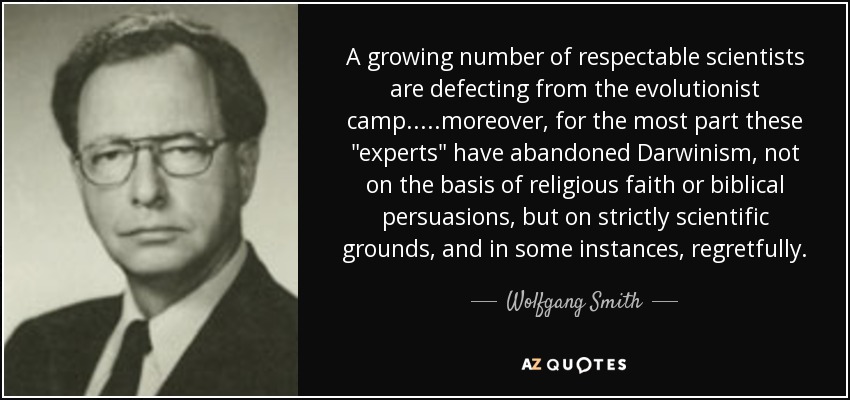


Wolfgang Smith, mathematician, physicist, philosopher of science, metaphysician, has written brilliantly on the plague of scientistic belief at:
http://www.catholic.net/rcc/Periodicals/HPR/April%202000/belief.html
 
...

 
I will go so far as to contend that religion goes astray the moment it relinquishes its just rights in the so-called natural domain nowadays occupied by science. I believe that the contemporary crisis of faith and the ongoing de-Christianization of Western society have much to do with the fact that for centuries the material world has been left to the mercy of the scientists. This has of course been said many times before (but not nearly often enough!). Theodore Roszak, for instance, has put it exceptionally well: “Science is our religion,” he observed, “because we cannot, most of us, with any living conviction see around it.” …. And one might add that perhaps only those who already have at least a touch of authentic religion do in fact stand a chance of “seeing around it with any living conviction.”
So too the name of Oskar Milosz (1877-1939) comes to mind, a European writer who had this to say: “Unless a man’s concept of the physical universe accords with reality, his spiritual life will be crippled at its roots, with devastating consequences for every other aspect of his life.” …. It could not have been better said! As regards the implications of the scientistic world-view for the life of the Church, let me quote from a recent book by the French philosopher Jean Borella: “The truth is that the Catholic Church has been confronted by the most formidable problem a religion can encounter: the scientistic disappearance (disparition scientifique) of the universe of symbolic forms which enable it to express and manifest itself, that is to say, which permit it to exist.” And he goes on to say: “That destruction has been effected by Galilean physics, not, as one generally claims, because it has deprived man of his central position—which, for St. Thomas Aquinas is cosmologically the least noble and the lowest—but because it reduces bodies, material substance, to the purely geometric, thus making it at one stroke scientifically impossible (or devoid of meaning) that the world can serve as a medium for the manifestation of God. The theophanic capacity of the world is denied.” …. Let us be clear about it: Borella is pointing the finger squarely at what I have termed physical reductionism: “le problème le plus redoubtable qu’une religion puisse rencontrer,” he calls it. What he terms a “reduction to the purely geometric” corresponds precisely to what I call the reduction of the corporeal to the physical: it is this scientistic contention that would obliterate “the theophanic capacity of the world.”
 
It is of course to be understood that the “symbolic forms” to which Borella refers are not, as some might think, subjective images or ideas which in days gone by men had projected upon the external universe, until, that is, science came to apprise us of the truth. The very opposite is in fact the case: The “forms” in question are objectively real and indeed essential to the universe. We may conceive of them as “forms” in the Aristotelian and Scholastic sense, or Platonically, as eternal archetypes reflected on the plane of corporeal existence. In either case they constitute the very essence of corporeal being. Remove these “symbolic forms,” and the universe ceases to exist; for it is these “forms,” precisely, that anchor the cosmos to God.
 
It is needless to point out that science has not in reality destroyed these forms, or caused their disappearance; however, the scientistic negation of corporeal being entails a denial of the substantial forms or essences which constitute that order of being, and of the sensible qualities by which these forms or essences manifest themselves to man. The scientistically prepared mind, therefore, has become increasingly insensitive to what Borella terms “the universe of symbolic forms,” to the point where that universe has become for it all but invisible. It is in that sense that the “theophanic capacity of the world” has been diminished to an unprecedented degree.
 
The consequences, however, of that diminution cannot but be tragic in the extreme. In his denial of essences, scientistic man has destroyed the very basis of the spiritual life. As Borella points out, he has obliterated the domain “that enables the Church to express and manifest itself,” and hence “permits it to exist.” The refutation of scientistic belief, therefore, is not an optional matter for the Church, something from which she can afford to abstain; it is rather a matter of urgent necessity, a question ultimately of survival.
It may be well, finally, to reflect anew upon what St. Paul has to say concerning “the theophanic capacity of the world” in his letter to the Romans. “For the invisible things of him from the creation of the world are clearly seen,” he declares, “being understood by the things that are made, even his eternal power and Godhead.” To which he adds: “So they are without excuse:
Because that, when they knew God, they glorified him not as God, neither were they thankful; but became vain in their imaginations, and their foolish heart was darkened. Professing themselves to be wise, they became fools” (Rom. 1:20-22).
I need hardly point out the striking relevance of these words to all that we have discussed. The “things that are made” are doubtless corporeal natures, the objects that man can perceive; and what about “the invisible things of him”: are these not precisely eternal essences, ideas or archetypes? So long as man’s heart has not been “darkened,” the sensory perception of “things that are made” will awaken in him an intellectual perception—a “recollection,” as Plato says—of the eternal things which the former reflect or embody. St. Paul alludes to a time or a state when man “knew God,” a reference, first of all, to the condition of Adam before the fall, when human nature was as yet undefiled by original sin. One needs to realize, however, that the fall of Adam has been repeated on a lesser scale down through the ages, in an unending series of “betrayals,” large and small. Even today, at this late stage of history, we are, each of us, endowed with a certain “knowledge of God” to which we can freely respond in various ways. And that is precisely why we, too, are “without excuse,” and why, to some degree at least, we are responsible for the opinions we hold concerning the cosmos. Everyone perceives the universe in accordance with his spiritual state: the “pure in heart” perceive it without fail as a theophany; and for the rest of us, whose “foolish hearts are darkened,” the theophanic capacity of the universe is reduced in proportion to this darkening.
 
I would like however to emphasize that this correspondence between our spiritual state and our Weltanschauung applies in both directions, which is to say that not only does our spiritual state affect the way we view the external world, but conversely, our views concerning the universe react invariably upon that state. This is in fact my central point: Cosmology matters, it has a decisive impact upon our spiritual condition. Even what we think about the purely physical world turns out to be crucial; for indeed, “unless a man’s concept of the physical universe accords with reality, his spiritual life will be crippled at its roots. . . .”
 
This brings us at last to the pastoral question: what can be done pastorally to counteract the scientistic influence? The major problem, clearly, is to inform the pastors themselves: to alert them, first of all, to the fact that there is a crucial distinction to be made between science and scientism, and then to the fact that scientistic belief is antagonistic to our spiritual well-being. This however will not be easy to get across, for it offends against the prevailing trend, both in civil society and within the Church. It is only by an act of grace, I surmise, that any of us are able to muster the discernment, and indeed the sheer boldness, to cast off the scientistic Weltanschauung and recover a Christian world-view. And this task, this imperative, I say, is at bottom spiritual. It is to be accomplished, thus, not simply by reading books, or through a process of reasoning, but above all through faith and prayer. The dictum credo ut intelligam applies to us still, and perhaps even more urgently than in the comparatively innocent days of Augustine or Anselm. It is needful that we be touched and enlivened by the Holy Ghost, the Spirit of truth, who “will guide you into all truth” (John 16:13). In our struggle to transcend the scientistic outlook, we are dealing, moreover, not simply with a belief system of human contrivance, but with something more formidable by far; for here too, in the final count, “we wrestle not against flesh and blood, but against principalities, against powers, against the rulers of the darkness of the world, against spiritual wickedness in high places” (Eph. 6:12). How could it be otherwise when it is “the theophanic capacity of the world” that stands at issue: the very thing “which enables the Church to express and manifest itself, that is to say, which permits it to exist.” ….

God’s will is clear: To seek out, save humanity from evil, pope says


God’s will is clear: To seek out, save humanity from evil, pope says

Pope Francis blows upon a flame of peace presented by the organization Earth Caravan during his general audience in St. Peter's Square at the Vatican March 20, 2019. Setsuko Thurlow, a survivor of the 1945 atomic bombing in Hiroshima, Japan, was a part of the group as they presented the flame in memory of the atomic bombings in Japan. (Credit Paul Haring/CNS.)

  • In Catholic News Service, Vatican
  • Carol Glatz
    Mar 20, 2019
  • Christians have faith in a God who wants to and is able to transform the world, conquering evil with good, Pope Francis said.

    ROME - Christians have faith in a God who wants to and is able to transform the world, conquering evil with good, Pope Francis said.
    That is why “it makes sense to obey and abandon oneself” to God and his will, even during life’s most difficult moments, the pope said March 20 during his general audience in St. Peter’s Square.
    Continuing a series of talks about the Lord’s Prayer, the pope focused on the line, “Thy will be done.” It is the third petition in the prayer right after, “hallowed be thy name” and “thy kingdom come.”
    God’s will - what he wants - is clearly illustrated throughout the Gospel, the pope said; it is “to seek out and save whoever is lost.”
    “Have you ever thought about what that means, that God is looking for me, for each one of us” personally, “knocking on the door of our heart” with love, hoping to capture people’s attention and take them by the hand toward salvation, the pope said.
    “God is not ambiguous,” Francis said. “He does not hide behind riddles” or inscrutable plans; he wants everyone to know the truth and be saved.
    The Our Father is a prayer asking that this desire be fulfilled and that each person and all of humanity be saved, he said.
    When people pray, “Thy will be done,” they are praying not as subservient “slaves” but as children who understand and trust their father and his loving plan, the pope said.
    “It is a courageous, even confrontational prayer because there are so many, too many things going on in the world that are not according to God’s plan,” he added.
    In a world experiencing war, hatred and exploitation, he said, people of faith know that God wants what is best, which is why they pray his will be done and that swords be turned into plowshares, because “God wants peace.”
    The Lord’s Prayer is meant to ignite the same deep love Jesus felt for his father, the same passion to “transform the world with love.”
    Christians do not believe in random, unalterable or “inescapable fate,” the pope said. Rather, they truly believe “that God can and wants to transform reality, conquering evil with good,” and this, he said, is why people pray.
    Even though Christ was being “crushed by the evil of the world,” he abandoned himself fully and confidently to God’s will, the pope said.
    That path to salvation may be difficult, and people may experience suffering, pain or harm, but God “will never abandon us. He will always be with us, next to us, within us.”
    “For a person of faith, this is more than a hope, it is a sure thing - God is with me.”
    Present at the pope’s general audience was Nobel Peace Prize recipient, Setsuko Thurlow, 87, a Japanese-Canadian survivor of the United States’ atomic bombing of Hiroshima in 1945. She received the prize in 2017 on behalf of the International Campaign to Abolish Nuclear Weapons.
    She was part of a delegation of activists led by Earth Caravan, an interfaith group based in Japan and Canada. The group visiting the Vatican was made up of people from different countries and cultures, including four 13-year-old girls - girls the same age as Thurlow when the bomb dropped on her city and killed her family.
    The group was to present Francis with an oil lamp lit with a flame that was taken from the burning ashes of the bomb dropped on Hiroshima. The flame, the group said on its website, has been burning continuously since Aug. 6, 1945.
    The group was going to ask the pope to blow out the flame they brought as a symbolic gesture of wishing for a world free of nuclear weapons and a brighter, more peaceful world.


    https://cruxnow.com/vatican/2019/03/20/gods-will-is-clear-to-seek-out-save-humanity-from-evil-pope-says/

    Sunday, March 10, 2019

    “The Lord is purifying his bride (the church) and is converting us all to himself”: Pope Francis


    Church Undergoing

    Test of prophet Job


    Part Three:

    “The Lord is purifying his bride (the church) and

    is converting us all to himself”: Pope Francis


    “[The Church's] structure is totally ordered to the holiness of Christ's members.

    And holiness is measured according to the 'great mystery' in which the Bride responds

    with the gift of love to the gift of the Bridegroom." …. Mary goes before us all in the holiness that is the Church's mystery as "the bride without spot or wrinkle."….

    This is why the "Marian" dimension of the Church precedes the "Petrine.”


    Catholic Catechism # 773


    Pope Francis has incorporated this theme of the Church having to undergo an intense purification so as to be “without spot or wrinkle” in his recent comment on the sexual abuse scandal: https://www.ncronline.org/news/vatican/francis-chronicles/pope-god-purifying-church-unbearable-pain-abuse-scandal


    pain of abuse scandal


    Rome — The clerical abuse scandal has caused everyone in the Catholic Church "pain and unbearable suffering," Pope Francis said, but it also is a call to repentance and the renewal of the church.

    "Our humble repentance, which remains silent between our tears for the monstrosity of sin and the unfathomable greatness of God's forgiveness, this, this humble repentance is the beginning of our holiness," the pope told priests from the Diocese of Rome.

    Pope Francis' annual Lenten meeting with the priests March 7 began with a penitential prayer service and individual confessions at the Basilica of St. John Lateran, the cathedral of the Diocese of Rome.


    In a long, impromptu talk on priesthood and forgiveness, the pope acknowledged the clerical sexual abuse crisis and the particular way it had impacted priests.


    "Sin disfigures us," he said, and it is "humiliating" when "we or one of our brother priests or bishops falls into the bottomless abyss of vice, corruption or, worse still, of a crime that destroys the lives of others," like the sexual abuse of minors does.

    Pope Francis said he is convinced the abuse scandal is ultimately the work of the devil.

    "Still, do not be discouraged," he told the priests. "The Lord is purifying his bride (the church) and is converting us all to himself. He is putting us to the test so that we would understand that, without him, we are dust."


    God is working "to restore the beauty of his bride, surprised in flagrant adultery," the pope said.

    Focusing much of his talk on the Exodus story of God forming his people, teaching them, castigating them and leading them to the promised land, Pope Francis insisted that God must teach his people humility so that they recognize he is God and they are totally dependent on him.


    When the ancient Israelites made the golden calf, he said, "a patient process of reconciliation began, a wise pedagogy through which God threatens and consoles, makes them aware of the consequences of the evil done and decides to forget their sin, punishes the people and heals the wounds he inflicted."

    God threatens to abandon his people, and he lets them experience some of what it might mean to be without him, the pope said. "We've experienced this, these awful moments of spiritual desolation."

    But the Lord always returns, allowing people to learn to fear their own powerlessness, their slyness, the way they say one thing and do another, he said.

    Confession, for priests like for any Catholic, is a moment of coming face to face with one's own weakness, being honest and saying out loud how one has sinned, he said. It's like removing the mask or makeup people usually wear so no one sees their faults.


    Pope Francis told the priests they should not expect to be always understood, accepted and appreciated, but "let us believe in the patient guidance of God, who does things in his time, opening our hearts and placing ourselves at the service of his word of reconciliation."

    [End of article]


    Related to this, the sexual abuse scandal, is the case of Australia’s George Cardinal Pell.

    A U.S. priest has just sent this article on Cardinal Pell from the National Catholic Register:


    Cardinal George Pell arrives at Melbourne County Court Feb. 27 in Melbourne, Australia. Cardinal Pell was found guilty Dec. 11, but the result was subject to a suppression order and was only able to be reported since Tuesday.

    Cardinal George Pell arrives at Melbourne County Court Feb. 27 in Melbourne, Australia. Cardinal Pell was found guilty Dec. 11, but the result was subject to a suppression order and was only able to be reported since Tuesday. (Scott Barbour/Getty Images)


    Commentary |  Mar. 1, 2019

    Calling Cardinal Pell’s Prosecution What It Is: Religious Persecution


    COMMENTARY: Now that the suppression order has been lifted, we are free to state what has been evident for several years now.


    Father Raymond J. de Souza


    Cardinal George Pell was exactly where he should have been Wednesday night in Melbourne: in jail.

    Let Henry David Thoreau explain: “Under a government which imprisons any unjustly, the true place for a just man is also a prison” (Civil Disobedience).

    Now that the peculiar “suppression order” in Australia has been lifted, we are free to state what has been evident for several years now. The prosecution of Cardinal Pell has been a monstrous miscarriage of justice, a religious persecution carried out by prosecutorial means.

    Cardinal Pell was convicted last December for sexually assaulting two 13-year-old boys in 1996. The process that led to the convictions was, from the start, a sustained and calculated strategy to corrupt the criminal-justice system toward politically motivated ends.

    And now Cardinal Pell is in jail, awaiting his sentencing next month. There is no shame that Cardinal Pell is in jail; the shame is sufficiently abundant to be worn by all those who put him there.


    False Accusations

    Miscarriages of justice do take place. Cardinal Pell himself was falsely accused in 2002, and, before him, Cardinal Joseph Bernardin of Chicago was falsely accused in 1993. Both those accusations were resolved with recourse to the police or courts.

    The case of Cardinal Pell, though, was not a miscarriage akin to a mistake. It was done with police and prosecutorial malice aforethought.

    Americans ought not be surprised by this, for the list of wrongfully convicted is very long indeed. Even some on death row have been exonerated before their executions could be carried out.


    Malicious Prosecution of Prominent People

    The most famous recent case in the U.S. is the 2008 conviction of Sen. Ted Stevens, R-Alaska, who lost a narrow re-election bid after a conviction for not reporting an alleged gift. Only after an FBI whistleblower revealed the grievous prosecutorial misconduct was Stevens exonerated. It came too late for his re-election, but his good name was restored. Stevens died in 2010.

    If a Republican-led Justice Department can deliberately, maliciously and wrongfully convict the longest-serving Republic senator in the land, still popular in his home state, it would be relative child’s play for prosecutors in Victoria (Cardinal Pell’s home state in Australia) to deliberately, maliciously and wrongfully convict Cardinal Pell, who has been subject to a yearslong campaign of media defamation in Australia. Such was the intensity of the vilification that it would likely be possible to find a jury of 12 people in Melbourne who would believe that Cardinal Pell had sexually abused the boys, too.

    Still, the case against Cardinal Pell was so grotesquely fantastical that it took the prosecutors two tries to get the convictions. The first trial, in September, ended in a hung jury, with jurors reportedly voting 10-2 to acquit. A retrial followed, with the jury reaching the necessary unanimity to convict in December.


    The Supposed Facts of the Case

    It is important for Catholics to know the specifics of the case, not just summary statements that it was “weak.” It was impossible.

    The prosecution charged that Cardinal Pell, instead of greeting people after Mass, as was his custom, immediately left everyone in St. Patrick’s Cathedral and went unaccompanied to the sacristy. Arriving alone in the sacristy, he found two choirboys who had somehow left the procession of the other five dozen choirboys and were swigging altar wine.

    Having caught them in the act, he then quickly decided to sexually assault them — “oral penetration,” to be unpleasantly precise.

    This he accomplished immediately after Mass, with the sacristy door open, despite having all his vestments on and with the reasonable expectation that the sacristan, the master of ceremonies, the servers or concelebrants might come in and out or even pass by the open door, as would be customary after Mass.


    Meanwhile, there were dozens and dozens of people in the cathedral, praying or milling about.

    The whole affair took place within six minutes, after which the boys went off to choir practice and never spoke about it to anyone for 20 years, not even to each other. Indeed, one of the boys, who died of a heroin overdose in 2014, explicitly told his mother before he died that he had never been sexually abused.

    The supposed facts are virtually impossible to complete. Ask any priest of a normal-sized parish — let alone a cathedral — if it would be possible to rape choirboys in the sacristy immediately after Mass. Sixty seconds — let alone six minutes — would not pass without someone, or several people, coming in and out, or at least passing by the open door. Ask any priest if he is customarily alone in the sacristy immediately after Mass, while there are still people in the church and the sanctuary has not yet been cleared.

    Furthermore — again, with apologies for being graphic — it is not possible to perform the alleged penetration when fully vested for Mass. Again, ask any priest — let alone an archbishop, who is more heavily vested — about the awkwardness of having to visit the bathroom, if necessary, after vesting. It requires divesting, at least in part, or engaging in an awkward handling of the various vestments, which makes using the washroom difficult, to say nothing of a sexual assault.

    The complainant said that Cardinal Pell had just moved his vestments aside, an impossibility, given that the alb has no such openings.

    What Cardinal Pell was accused of doing is simply impossible, even if he had somehow been mad enough to attempt it. Moreover, any man who attempts raping boys in a public place with people about is the kind of reckless offender about whom there would be a long history of such behavior. There is, of course, no such history.


    The Corruption of the Police

    It is not astonishing that a jury of 12 ordinary citizens might be convinced, contrary to evidence and common sense, that Cardinal Pell was guilty. After all, dozens and dozens of highly trained and experienced police officers and prosecutors decided that the former archbishop of Sydney was guilty even before any charges were brought whatsoever. Such is the Australian hatred for the Catholic Church in general and George Pell in particular.

    In 2013, the Victoria police launched “Operation Tethering” to investigate Cardinal Pell, even though there had been no complaints against him. There followed a four-year campaign to find people willing to allege sexual abuse, a campaign that included the Victoria police taking out newspaper ads asking for complaints about sexual abuse at the Melbourne cathedral — before there had been any.

    The police had their man and just needed a victim.

    With Australia going through the agony of a royal commission investigation into sexual abuse — with the Catholic Church garnering the lion’s share of the attention — it was only a matter of time before someone could be found to say something, or remember something, or, if necessary, fabricate it altogether. That, after all those efforts, the Victoria police could only pull together such a flimsy case is itself a powerful indication that Cardinal Pell is not a sexual abuser.


    Testimony — or Not — of the Complainants

    In Victoria sexual-abuse cases, the victim testifies in closed court, so the public does not know, and cannot evaluate, the credibility of what was said.

    In the first trial, the complainant testified before the jury. They voted not to convict. In the second trial, the complainant did not testify at all, but the records of his testimony in the first trial were entered instead. It appears that the first jury, who heard the complainant live, found him less credible than the second jury, which did not encounter him live.

    Cardinal Pell was thus convicted on the testimony of a single witness who presented an incredible story, without corroboration, without any physical evidence and without any previous pattern of behavior, over the strenuous insistence by the alleged perpetrator that nothing of the sort ever took place. That, almost by definition, meets the standard of reasonable doubt.

    Even more astonishing, the jury convicted Cardinal Pell of assaulting the second boy, even though he had denied to his own family ever being molested. The second supposed victim died in 2014. He never made a complaint, was never interviewed by the police and was never examined in court.

    Absent the public hatred for Cardinal Pell, such a case would never have even been brought to court. But just as the police had their man before they had any allegations or evidence, the prosecutors knew that they had a good chance of getting a jury that was so determined to get Cardinal Pell that they only had to give them a chance.


    A Secret Trial

    Under Victoria law, a judge can issue a “suppression order” that bans any and all reporting on a case if it is thought necessary to protect a trial from undue public pressure. The “suppression order,” which meant that even the charges against Cardinal Pell were not revealed until this week, more than two months after his conviction, was ostensibly to protect Cardinal Pell’s right to a fair trial.

    In effect, it protected the prosecutors from having to defend the weakness of their case in the court of public opinion. If, almost two years ago, the prosecutors had had to argue in public that Cardinal Pell had raped two choirboys in a crowded cathedral immediately after Sunday Mass, there would have been at least some pressure on the Victoria attorney general to review whether mob justice was afoot, as it was last year in Australia, where Archbishop Philip Wilson of Adelaide was convicted of covering up a sexual-abuse case. He was convicted, and though he did not want to resign before his appeal was heard, pressure from the Vatican, his brother bishops and the Australian prime minister forced him out.

    Only months later, he was acquitted on appeal, with the appellate court judge ruling that the jury who convicted him was likely swayed by the public fury at the Catholic Church.

    It happened again.

    Father Raymond J. de Souza is the editor in chief of Convivium magazine.


    Saturday, March 9, 2019

    Pope: God is purifying the church with 'unbearable' pain of abuse scandal


    Rome — The clerical abuse scandal has caused everyone in the Catholic Church "pain and unbearable suffering," Pope Francis said, but it also is a call to repentance and the renewal of the church.
    "Our humble repentance, which remains silent between our tears for the monstrosity of sin and the unfathomable greatness of God's forgiveness, this, this humble repentance is the beginning of our holiness," the pope told priests from the Diocese of Rome.
    NCR's Daily Lenten Reflections
    Sign up for inspiring emails each day during Lent.
    Pope Francis' annual Lenten meeting with the priests March 7 began with a penitential prayer service and individual confessions at the Basilica of St. John Lateran, the cathedral of the Diocese of Rome.
    In a long, impromptu talk on priesthood and forgiveness, the pope acknowledged the clerical sexual abuse crisis and the particular way it had impacted priests.
     
    "Sin disfigures us," he said, and it is "humiliating" when "we or one of our brother priests or bishops falls into the bottomless abyss of vice, corruption or, worse still, of a crime that destroys the lives of others," like the sexual abuse of minors does.
    Pope Francis said he is convinced the abuse scandal is ultimately the work of the devil.
    "Still, do not be discouraged," he told the priests. "The Lord is purifying his bride (the church) and is converting us all to himself. He is putting us to the test so that we would understand that, without him, we are dust."
     
    God is working "to restore the beauty of his bride, surprised in flagrant adultery," the pope said.
    When the ancient Israelites made the golden calf, he said, "a patient process of reconciliation began, a wise pedagogy through which God threatens and consoles, makes them aware of the consequences of the evil done and decides to forget their sin, punishes the people and heals the wounds he inflicted."
    God threatens to abandon his people, and he lets them experience some of what it might mean to be without him, the pope said. "We've experienced this, these awful moments of spiritual desolation."
    But the Lord always returns, allowing people to learn to fear their own powerlessness, their slyness, the way they say one thing and do another, he said.

    Confession, for priests like for any Catholic, is a moment of coming face to face with one's own weakness, being honest and saying out loud how one has sinned, he said. It's like removing the mask or makeup people usually wear so no one sees their faults.

    Pope Francis told the priests they should not expect to be always understood, accepted and appreciated, but "let us believe in the patient guidance of God, who does things in his time, opening our hearts and placing ourselves at the service of his word of reconciliation."

    https://www.ncronline.org/news/vatican/francis-chronicles/pope-god-purifying-church-unbearable-pain-abuse-scandal

    Friday, March 8, 2019

    Pope on Women’s Day: women build world with peace, love


    womens-day-img


    During a meeting a delegation of the American Jewish Committee on March 8, Pope Francis recalled women’s contribution to peace and love in “making humanity a family”. He also spoke about anti-Semitism, indifference and dialogue.


    By Robin Gomes


     Pope Francis on Friday marked International Women’s Day, stressing the “irreplaceable contribution of women in building a world that can be a home for all,” through their efforts toward peace and love.  “Women make the world beautiful, they protect it and keep it alive.”  “They bring the grace of renewal, the embrace of inclusion, and the courage to give of oneself,” he told some 40 representatives of the American Jewish Committee who met him in the Vatican.

    Women – peace, love, family

    Speaking about the role of women in “making humanity a family”, the Pope said that peace, born of women, “arises and is rekindled by the tenderness of mothers.”  “Thus the dream of peace becomes a reality when we look towards women.”  He said they “dream of love into the world”.  “If we take to heart the importance of the future, if we dream of a future peace, we need to give space to women,” the Pope urged.
    The Holy Father also spoke to the American Jewish Committee about the commitment of Jews and Christians “to create a homely and familial environment,” through respect and appreciation for the religion of others”, which he said is “our future.”

    Anti-Semitism

    The Pope expressed great concern over outbreaks of anti-Semitic attacks in various countries and a “climate of wickedness and fury, in which,” he said, “an excessive and depraved hatred is taking root.”   Such a phenomenon, he said, calls for vigilance warning that even the slightest perceptible forms of anti-Semitism can lead to human tragedies such as the Shoah in which two-thirds of European Jewry were annihilated.
    The Pope stressed that any antisemitism on the part of a Christian is a rejection of one’s own origins, a complete contradiction.  He said, “We must not tire of transmitting to children the foundations of love and respect, and we must look at the world with the eyes of a mother, with the gaze of peace.”
    An important tool in the fight against hatred and antisemitism, the Pope pointed out, is interreligious dialogue, that aims at promoting a commitment to peace, mutual respect, the protection of life, religious freedom, and the care of creation.

    Overcoming indifference

    Since Jews and Christians have a common rich spiritual heritage, the Pope said, they can bring about much good together.  At a time when the West is exposed to a " depersonalizing secularism", he said, Jews and Christians need to come together and cooperate in making divine love more visible for humanity, and to carry out concrete gestures of closeness to counter the growth of indifference.
    Pointing to the indifference of Cain before he killed his brother, Abel, Pope Francis lamented the growing distance today between the many who have little and the few who have much. “We are called to take care of the most vulnerable of our brothers and sisters: the poor, the weak, the sick, children, and the elderly,” he urged.

    Youth and dialogue

    Pope Francis also underscored the involvement of young people in serving humanity, saying they want to dream and are open to discovering new ideals .  He called for the formation of future generations in Jewish-Christian dialogue saying it is also an effective means of countering violence and opening new paths of peace with all.


    https://www.vaticannews.va/en/pope/news/2019-03/pope-francis-american-jews-women-antisemitism-indifference-dialo.html


    Thursday, February 28, 2019

    Vital devotions to the Sacred Heart of Jesus


    Enthronement of the Sacred Heart at home,
    and the Nine First Fridays of Reparation.
     
    Philip Kosloski of Aleteia lays it out at:
    https://aleteia.org/2016/04/29/5-things-catholics-should-know-about-first-fridays/
     

    5 Things Catholics Should Know About First Fridays

    Learn about devotion to the Sacred Heart of Jesus and the graces that come from observing First Fridays

     
    It is no wonder, therefore, that our predecessors have constantly defended this most approved form of devotion — the pious devotion of the faithful toward the Most Sacred Heart of Jesus [and] the custom of receiving Holy Communion on the first Friday of every month at the desire of Christ Jesus, a custom which now prevails everywhere.—Pope Pius XI Miserentissimus Redemptor
     
    What’s so special about First Fridays?
     
    Our parents grew up going to church every First Friday of the month and taking part in Sacred Heart devotions, but in recent decades the pious practice has fallen out of practice, and is dismissed by some as an “old-fashioned” anachronism.
    A main reason for the decline in interest in this devotion is probably rooted in simple ignorance: people don’t know what First Fridays are all about; families and parishes may not have adequately passed down their importance to the next generation. Here are five things to know.
     
    1. How did the First Friday Devotion begin?
     
    While some saints referenced the Heart of Jesus in their writings even centuries earlier, in 1673, a French Visitandine (Visitation) nun named Margaret Mary Alacoque had visions of Jesus, wherein he asked the Church to honor His Most Sacred Heart. In particular, Jesus asked the faithful to “receive Communion on the First Fridays, for nine consecutive months.” The request was connected to a specific promise made to all who venerated and promoted devotion to the Sacred Heart. After Margaret Mary’s death, the First Friday practice steadily spread in the Church — endorsed by popes and promoted by saints — but it greatly increased in popularity when Margaret Mary was canonized a saint in 1920 by Pope Benedict XV.
     
    1. Why nine consecutive months?
     
    The number nine is traditionally associated with a novena and finds its origin in the nine days that the apostles spent in prayer before Pentecost. A novena provides an extended amount of time for preparation and interior renewal.
     
    1. What am I supposed to do on First Fridays?
     
    Go to Mass and receive Holy Communion with the intention of honoring Christ’s Sacred Heart. If you are not in a state of grace, and thus unable to receive, you will also need to go to confession.
     
    1. What are the “promises” connected to this devotion?
     
    Jesus said to St. Margaret Mary, “In the excess of the mercy of my heart, I promise you that my all powerful love will grant to all those who will receive communion on the First Fridays, for nine consecutive months, the grace of final repentance: they will not die in my displeasure, nor without receiving the sacraments; and my heart will be their secure refuge in that last hour.” This means that if a person faithfully receives communion for nine consecutive months on First Fridays, Jesus will grant that person extra graces at the time of their death, making it possible to repent of their sins and receive the last rites (if needed).
    This promise is the last of 12 promises connected to the Devotion to the Sacred Heart, particularly attached to the Enthronement of the Sacred Heart in one’s home:
     
    (1) I will give them all the graces necessary in their state of life.
    (2) I will establish peace in their homes.
    (3) I will comfort them in all their afflictions.
    (4) I will be their secure refuge during life, and above all, in death.
    (5) I will bestow abundant blessings upon all their undertakings.
    (6) Sinners will find in my heart the source and infinite ocean of mercy.
    (7) Lukewarm souls shall become fervent.
    (8) Fervent souls shall quickly mount to high perfection.
    (9) I will bless every place in which an image of my heart is exposed and honored.
    10) I will give to priests the gift of touching the most hardened hearts.
    (11) Those who shall promote this devotion shall have their names written in my Heart.
    (12) I promise you in the excessive mercy of my Heart that my all-powerful love will grant to all those who receive Holy Communion on the First Fridays in nine consecutive months the grace of final perseverance; they shall not die in my disgrace, nor without receiving their sacraments. My divine heart shall be their safe refuge in this last moment.
     
    1. Are the First Fridays a “ticket” to heaven?
     
    It is not as simple as going to Mass for nine months and then clocking out, never going to Mass again and leading a sinful life! The entire purpose of this devotion is to draw a person closer to the heart of Christ. If a person fulfills these obligations with sincere faith, it is natural for he or she to be closer to God and better prepared for death. The moment that this devotion is observed in a superstitious manner, neglecting the need to live a virtuous life, all bets are off and Jesus’ promise is null and void.
    Jesus wants us to rest on his heart, like St. John, and the First Friday devotion is an opportunity for us to encounter him more than just on Sundays and to deepen our love of him.
    Coming to know, love and trust that we may take rest in the Sacred Heart of Jesus, and place our anxieties within, is what the First Fridays are all about.
    [Editor’s Note: Take the Poll – Do You Still Celebrate First Fridays?]
     
    1st (Friday) March, 2019