Translate

Sunday, November 18, 2018

The Cross of Jesus Christ – this is the “fifth essence”, the “philosopher’s stone”


Image result for jesus loves you this much


“As you come to him, the living Stone—rejected by people but chosen by God and precious to him—you also, like living stones, are being built into a spiritual house to be a holy priesthood, offering spiritual sacrifices acceptable to God through Jesus Christ. For in Scripture it says: ‘See, I lay a stone in Zion, a chosen and precious cornerstone, and the one who trusts in him will never be put to shame’.”
As you come to him, the living Stone—rejected by humans but chosen by God and precious to him— 5you also, like living stones, are being built into a spiritual house to be a holy priesthood, offering spiritual sacrifices acceptable to God through Jesus Christ.
As you come to him, the living Stone—rejected by humans but chosen by God and precious to him— 5you also, like living stones, are being built into a spiritual house to be a holy priesthood, offering spiritual sacrifices acceptable to God through Jesus Christ.As you come to him, the living Stone—rejected by humans but chosen by God and precious to him— 5you also, like living stones, are being built into a spiritual house to be a holy priesthood, offering spiritual sacrifices acceptable to God through Jesus Christ.I Peter 2:4-6
 
 
St. Louis Grignion de Montfort wrote:
 
I am a poorly polished stone,
Crude and without adornment,
Shape it, Lord, I beg you,
To set it in your building.
 
I want to suffer in patience,
Cut, shape, strike, slice,
But help my helplessness
And forgive me my sins.
 

The Cross of Jesus Christ is the true Alchemy, the ‘philosopher’s stone’, the ‘fifth essence’, for which the ancient sages had sought so eagerly.
It is the Science of all sciences: “Strive then to become proficient in this all-important science under your great Master, and you will understand all other sciences, for it contains them all in an eminent degree”.
 
....
Taken from Friends of the Cross,
by St. Louis Grignion de Montfort
 
….
The mystery of the Cross is a mystery unknown to the Gentiles, rejected by the Jews, and despised by heretics and bad Catholics. But it is the great mystery you must learn to practice in the school of Christ, and which can only be learnt from him. You will look in vain in all the schools of ancient times for a philosopher who taught it; in vain you will appeal to the senses or to reason to throw some light on it. It is only Jesus, through his all-powerful grace, who can teach you this mystery and give you the ability to appreciate it.
 
Strive then to become proficient in this all-important science under your great Master, and you will understand all other sciences, for it contains them all in an eminent degree. It is our natural and supernatural philosophy, our divine and mystic theology, our philosopher’s stone, which by patience transforms the basest metals into precious ones, the bitterest pains into delight, poverty into riches, the most profound humiliations into glory. The one among you who knows best how to carry his cross, even though in other things he does not know A from B, is the most learned of all.
 
The great St. Paul returned from the third heaven, where he learned mysteries hidden even from the angels, and he proclaimed that he did not know, nor did he want to know anything but Christ crucified. Rejoice, then, you ordinary Christian, man or woman, without any schooling or intellectual abilities, for if you know how to suffer cheerfully, you know more than a doctor of Sorbonne University who does not know how to suffer as you do. ….
 
Philippians 3:8-11
 
I consider everything a loss because of the surpassing worth of knowing Christ Jesus my Lord, for whose sake I have lost all things. I consider them garbage, that I may gain Christ and be found in him, not having a righteousness of my own that comes from the Law, but that which is through faith in Christ—the righteousness that comes from God on the basis of faith. I want to know Christ—yes, to know the power of his Resurrection and participation in his sufferings, becoming like him in his death, and so, somehow, attaining to the resurrection from the dead.
 
 
Image result for cross a stone of stumbling

Saturday, November 17, 2018

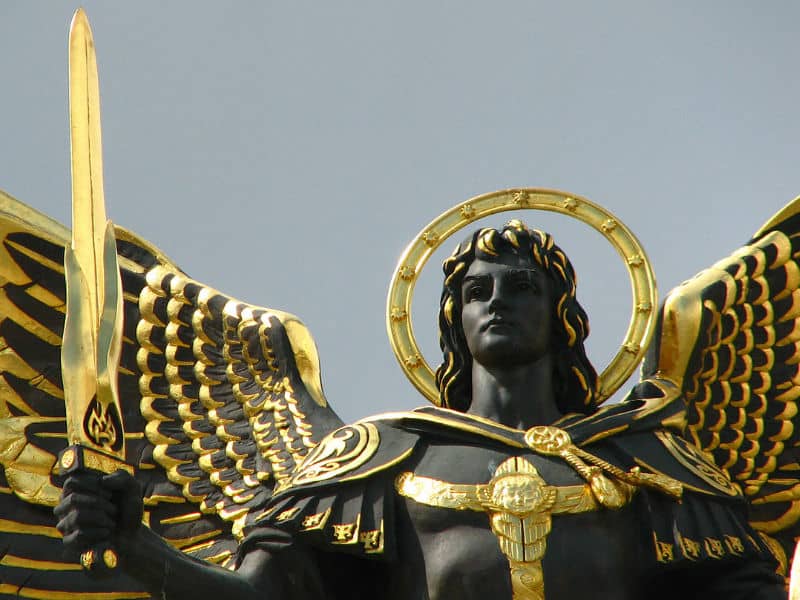
Michael the great prince


Daniel 12:1-3


At that time Michael, the great prince who stands watch over your people, will rise up.
There will be a time of distress such as never has occurred since nations came into being until that time.

But at that time all your people who are found written in the book will escape.

Many who sleep in the dust of the earth will awake, some to eternal life, and some to disgrace and eternal contempt.

Those who have insight will shine like the bright expanse of the heavens, and those who lead many to righteousness, like the stars forever and ever. ....
 

Thursday, November 15, 2018

Pope Francis: A Christian’s life should point to truth


Christians are called not only to refrain from telling falsehoods, but to conduct their entire lives – both words and actions – as a witness to the Truth that is Jesus Christ, Pope Francis said Wednesday.
ROME - Christians are called not only to refrain from telling falsehoods, but to conduct their entire lives - both words and actions - as a witness to the Truth that is Jesus Christ, Pope Francis said Wednesday.

“Let us ask ourselves: what truth do the works of us Christians attest to, our words, our choices?” the pope said Nov. 14. “Everyone can ask themselves: am I a witness to the truth, or am I more or less a liar disguised as a true person?”

In his weekly catechesis, Francis reflected on the eighth commandment: “You shall not give false witness against thy neighbor.”
“The truth,” he said, “finds its full realization in the very person of Jesus, in his way of living and dying, the fruit of his relationship with the Father.” As children of God, people are given this same access to truth, sent through the Holy Spirit, “who is the Spirit of truth, who attests to our hearts that God is our Father.”

Francis explained that “in every one of his actions man affirms or denies this truth. From small everyday situations to the most demanding choices. But it is the same logic: that which parents and grandparents teach us when they tell us not to lie. The same logic.”

According to the Catechism of the Catholic Church, the pope said, the commandment against lying, “forbids falsifying the truth in relations with others.”
“Inauthentic communication” is a serious error because it prevents relationships and love, which require truth; and “where there is a lie there is no love, there can be no love,” he emphasized.
To tell the truth in one’s relationships means more than to just not tell a falsehood with one’s words, he continued, listing also “gestures, attitudes, silences, and absences,” as possible occasions of dishonesty.
“A person speaks with everything he is and what he does. We are always in communication. We all live by communicating and we are constantly poised between truth and falsehood,” he stated.
An element of telling the truth in relationships includes not gossiping, he said, departing from his prepared remarks to emphasize that to gossip is like dropping a bomb, which destroys the community and the reputation of others.

“Be careful!” he urged. “How much gossip destroys communion for inappropriateness or lack of delicacy!”

Just because one may have told the truth about another person, does not mean it was right to say it, or to reveal some personal or confidential information, Francis warned.

Christians are not exceptional people, but “we are children of the heavenly Father, who is good and does not disappoint,” therefore, Christians are able to live in the truth “not so much said with discourses,” he said, but as a “way of existing, a way of life, and it is seen in every single act.”
“Truth is a marvelous revelation of God, of his Father’s face, is his boundless love,” he said.

The question, “what is truth?” Francis noted, is what Pontius Pilate asked Jesus when he questioned him about his kingship before handing him over to the Jewish people to be crucified.
Jesus said: “For this I was born and for this I came into the world, to testify to the truth.” Jesus gives this “testimony” by his passion and death, the pontiff said. Through his manner of suffering and dying, “Jesus manifests the Father, his merciful and faithful love.”
“Not to say false testimony means to live as a child of God… letting the great truth emerge in every act: that God is Father and we can trust Him. I trust God: this is the great truth,” he concluded.
“From our trust in God, who is a Father and loves me, loves us, my truth is born; and to be truthful and not a liar.”


Wednesday, October 17, 2018

Pope Francis: To hate is to kill in the heart


Pope Francis at the general audience Sept. 5, 2018. Credit: Daniel Ibanez/CNA.


.- A person may not have killed someone, but if they are angry or have hate toward another person, it is like they have killed him or her in their heart, Pope Francis said Wednesday.
To insult or hate someone, or to have contempt, is a way of “killing the dignity of a person,” the pope said Oct. 17.
One may think: “I’m fine because I do not do anything wrong,” but he or she is deceiving themselves, he continued. “A mineral or a plant, or the sampietrini stones in the piazza, have this kind of existence, a person – a man or a woman – no.”

“More is required of a man or woman,” he stated. “Human life needs love.”
Pope Francis continued his series of messages on the Ten Commandments at the general audience with a reflection on Christ’s teachings about anger and its connection to the fifth commandment: You shall not kill.
Francis referenced the Gospel of Matthew, when Jesus is teaching his disciples on the mountain, and says: “You have heard that it was said to your ancestors, ‘You shall not kill; and whoever kills will be liable to judgment.’ But I say to you, whoever is angry with his brother will be liable to judgment.”
In this passage, the pope explained, Jesus reveals to his followers that “before God’s court, even anger against a brother is a form of murder.”
Jesus also says that, by the same logic, insult and contempt are sins too, he added, pointing out how often people are accustomed to insulting others, even commenting sometimes that so-and-so “is dead to me.”
To do so is like killing them in your heart, the pope said: “Jesus says stop!”
Pope Francis said the commandment to not kill is more than an order against bad actions, it is also “an appeal to love and mercy, it is a call to live according to the Lord Jesus, who gave his life for us and rose for us.”
“And what is authentic love? It is what Christ showed us, that is, mercy. The love we cannot do without is the one that forgives, which welcomes those who have harmed us.”
Pope Francis advised Catholics, before the start of Mass, to strive to be reconciled with anyone they have a problem with and to fight against the temptation to be indifferent toward their fellow human beings.
He pointed to Cain in the Old Testament, who said after he killed his brother Abel, “Am I my brother’s keeper?” This is how killers speak, the pope emphasized: “Are we the keepers of our brothers? Yes, we are! We are the keepers of each other!”
There is more to a person than his or her physical body – there is the spirit, he added, saying that even “an inappropriate phrase is enough to violate the innocence of a child.”
He concluded by urging Catholics to give thanks to Jesus, “the author of life.” In Christ, “in his love [which is] stronger than death, and through the power of the Spirit that the Father gives us, we can welcome the Word ‘Do not kill’ as the most important and essential appeal: to not kill is the call to love.” https://www.catholicnewsagency.com/news/pope-francis-to-hate-is-to-kill-in-the-heart-25134

Monday, October 1, 2018

Pope wants rosary prayed to protect Church from devil’s ‘turbulence’


To protect the Church during a period of "spiritual turbulence," Pope Francis has asked Catholics around the world to pray the rosary every day during the month of October.

ROME - In a move suggesting Pope Francis believes the Church is in a moment of “spiritual turbulence,” the pontiff is asking Catholics around the world to pray the rosary every day during the month of October for protection of the Church from the devil.


The daily praying of the rosary during the “Marian month of October,” a Vatican statement Saturday said, will unite the faithful “in communion and penance, as a people of God, in asking the Holy Mother of God and St. Michael the Archangel to protect the Church from the devil, who always aims to divide us from God and among us.”
The statement also says that, as the pope noted during his daily homily on Sept. 11, prayer is the weapon against “the Great accuser who ‘travels around the world looking for accusations’.”


RELATED: Pope Francis: Don’t use logic of the ‘Great Accuser’ who doesn’t know ‘mercy’


Beyond daily praying of the rosary, the pope is also requesting that the faithful add two prayers: An ancient invocation Sub Tuum Praesidium and a prayer to Saint Michael the Archangel “who protects and helps fight against evil,” according to the Book of Revelations.


The Vatican statement also said that the pope has tasked Jesuit Father Fréderic Fornos, who heads the Pope’s Worldwide Prayer Network, to spread this appeal. The Spanish priest heads the network once known as the Apostleship of Prayer, responsible for the pope’s monthly prayer videos. October’s intention, planned a year in advance, is supposed to be “The Mission of Religious.”
“Only prayer can defeat [the devil],” said the statement. “The Russian mystics and the great saints of all traditions advised, in moments of spiritual turbulence, to protect themselves under the mantle of the Holy Mother of God by pronouncing the invocation Sub Tuum Praesidium.”


The Marian prayer also known in English as “Beneath Thy Protection” is the oldest hymn dedicated to the Virgin and is well known among many Catholics, Eastern Orthodox and Oriental Orthodox countries, and is often a favorite song used along with Salve Regina.


With the request announced on Saturday, the pope is “asking the faithful of the whole world to pray so that the Mother of God puts the Church under her protective mantle to preserve her from the attacks of the evil one, the great accuser, and to make [the Church] all the more conscious of the faults, the mistakes, the abuses made in the present and in the past, and more committed to fighting without any hesitation for evil not to prevail.”


The prayer to St. Michael the Archangel was written by Pope Leon XIII and incorporated into the rubrics of the Low Mass of the Church from 1886 to its suppression in 1964, which became effective a year later, after the Second Vatican Council. It was originally destined as a prayer for the independence of the Holy See and the pope’s temporal sovereignty.
After the signing of the Lateran Treaties in 1929 that led to the creation of the Vatican City State, the prayer remained in the Missal but was instead offered “to permit tranquility and freedom to profess the faith to be restored to the afflicted people of Russia.”


Pope Francis is not the first pope to ask the faithful to recite this prayer since 1964. John Paul II did so in 1994, saying that “although this prayer is no longer recited at the end of Mass, I ask everyone not to forget it and to recite it to obtain help in the battle against the forces of darkness and against the spirit of this world.”


https://cruxnow.com/vatican/2018/09/29/pope-wants-rosary-prayed-to-protect-church-from-devils-turbulence/